Library of Congress credentials.
Garage-floor soul.™
Garage-floor soul.™


Close your eyes for a second and imagine it’s June 2002. The air at the Circuit de la Sarthe is thick with the scent of unburnt fuel and expensive French tobacco.
A yellow C5-R screams past the grandstands, the ground shaking beneath your feet as it hunts down Ferraris and Porsches. That car isn’t just winning; it’s dominating.
Now, flash forward to September 7th, 2025. It’s just past 7:00 AM at the Town Center Mall at Cobb.
We were there for the “golden morning hour,” a window of time when the sun isn’t just rising; it’s illuminating the world in a way that feels cinematic.
As the sun crested the horizon, it cast a long, amber glow across the asphalt, perfectly highlighting the aggressive curves of two identical 2004 Z06 Le Mans Blue Z16 Corvettes parked side-by-side.
In that light, the silver-and-red “Speed Stripes” didn’t just sit on the paint; they seemed to glow, drawing your eye down the hood and into the front air intakes.
Most cars were still trickling into the back of the lot for Caffeine and Octane, but these twin Fixed Roof Coupes (FRC) were already making a statement.
Standing there, as the sun warmed the cool morning air, you realized you weren’t looking at 20-year-old Chevys; you were looking at the Z16—the street-legal soul of a global conqueror.
This was the C5’s valedictory lap. It was the moment Chevrolet stopped apologizing for being an American sports car and started demanding respect on the world stage.
Also, for those who want to know more about this important generation of America’s Sports Car, we have put together: C5 Corvette Deep Dive: The Modern Comeback

The Z16’s most enchanting secret is hidden in plain sight. At first glance, the hood looks like any other perfectly painted body panel.
But run your hand along it, and you’re touching a piece of aerospace history. This was the first time a mass produced North American car was allowed to wear a painted carbon fiber “Class A” exterior skin.
GM partnered with Toray to solve the “telegraphing” effect (where the weave shows through paint). By using Toray T600-24K fibers in a unidirectional layout with G83 “quick-cure” epoxy resin, they created a panel that cured in under 10 minutes at 150°C.
Standing there at Town Center, I asked the owner about that first moment of discovery. He grinned, nodding toward his FRC Z06: “Most people walk by and think it’s just a cool paint job. But when that sun hits it just right—like it is right now—and I pop that hood to show them the raw, dark unidirectional carbon weave underneath, the conversation changes. It’s like a hidden badge of honor. It’s the secret handshake of the Corvette world.”

In performance engineering, weight is the enemy. For the Z16, GM utilized a light-weighting masterclass to improve the polar moment of inertia, allowing the car to rotate into corners with less effort.
| Component | Weight Saved | Technical Benefit |
| Toray Carbon Fiber Hood | 10.6 lbs | Reduces “nose-heavy” bias; improves turn-in. |
| Titanium Exhaust System | 19.2 lbs | Reduces rear overhang; 40% lighter than steel. |
| Thinner AP Technoglass | 5.0 lbs | Lowers center of gravity; Z06/Z16 specific. |
| Total Weight Reduction | ~34.8 lbs | Result: The most agile C5 ever produced. |
In the hands of a master, that’s not just weight; that’s agility.
It shifted the center of gravity rearward and downward, sharpening the turn-in response to a razor’s edge.

While the LS6 engine often gets the glory, the Z16’s true magic is hidden in the wheel wells. In Spring 2002, Chief Engineer Dave Hill sent Ride and Handling guru Michael Neal to Germany’s Nürburgring with a singular mission: make the final C5 the absolute best of its breed.
During these high-velocity sessions, the development prototype earned a gritty, unofficial nickname among the engineering team: the “Blue Bullet.” This wasn’t a polished PR label; it was a badge of respect coined by Neal and his team as they relentlessly hunted a sub-8-minute lap.
The “Blue Bullet” became the bridge between a production street car and the C5-R factory racers, spending three separate tuning trips on the Nordschleife.
By obsessing over the “force-velocity” curves of the Sachs shocks, Neal achieved what he described as a “total win-win.”
The finalized tuning resulted in a car that handled with far more ferocity on the track while—counterintuitively—maintaining a more sophisticated and compliant ride on the street than any previous Z06.
Neal’s breakthrough wasn’t about “stiffening” the car—the Z16 actually retains the same spring rates as the 2002–2003 Z06. Instead, the team obsessed over the force-velocity curves of the Sachs mono-tube shocks, specifically targeting rebound damping.
A common question among 2026 collectors is why the Z16 lacks the F55 Magnetic Selective Ride Control found on the Commemorative Coupes and Convertibles. For the 7:56 Nürburgring mission, the F55 was rejected for two clinical reasons:
To support the revised damping, Neal refined the mechanical pivot points of the chassis:
| Feature | The Z16 “Ring” Spec | Standard C5 / Z06 | Performance Impact |
| Damping Logic | 15% Increase in Low-Speed Rebound | Standard Linear Damping | Settles the chassis instantly after high-speed crests. |
| Impact Handling | Reduced High-Speed Compression | Standard Compression | Allows tires to “blow off” sharp impacts without upsetting grip. |
| Shock Hardware | FE4 Sachs Fixed-Valve Mono-tube | F55 Magnetic / Standard | Provides 100% linear, analog feedback at the limit. |
| Front Bushings | Stiffer Upper Control-Arm units | Standard Rubber | Eliminates steering “mush” during threshold braking. |
| Rear Bushings | Softer Anti-Roll Bar units | Standard High-Durometer | Promotes “squat” for maximum traction on corner exit. |
| Chassis Weight | Lightest (Reduced by ~35 lbs) | Standard Base Weight | Improves “Polar Moment of Inertia” (Sharper turn-in). |

| Benchmark | Specification |
|---|---|
| Nürburgring Lap Time | 7:56 (First production Vette under 8 mins) |
| 0–60 MPH | 3.9 Seconds |
| 1/4 Mile | 11.9 Seconds @ 116 mph |
| Top Speed | 171 mph (Gearing Limited) |
| Skidpad G-Force | 0.99g |
Neal’s refinements included:

The Z16 isn’t just a styling package; it is a direct descendant of the C5-R GTS program, a program that, by 2004, had become an unstoppable force in global motorsport.
While the street-legal Z16 was hitting showroom floors, its racing sibling was busy completing a near-perfect “swan song” season.
Built by Pratt & Miller and powered by a thundering 7.0-liter V8, the 2004 C5-R achieved a level of dominance rarely seen in racing history:
This racing dominance bled directly into the Z16’s DNA. While the C5-R utilized a 7.0L monster, the street Z16 focused on the LS6 V8. This 405-horsepower heart utilized a sand-cast block for strength and a “hotter” camshaft to handle its 6,600 RPM redline.

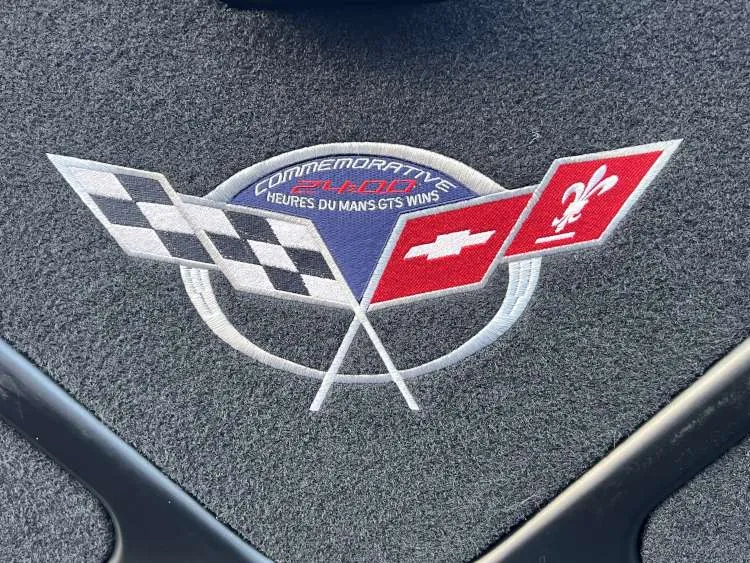
While the exterior is a masterclass in carbon fiber and Le Mans Blue, the final proof of a Z16’s pedigree is found in the driver’s seat. Unlike the standard Z06, which features a monochrome black interior, the Z16 Commemorative Edition includes unique branding designed to remind the driver of its racing lineage.
The Verification Checklist:
Elite Tip: If you are inspecting a “Z16” and the headrests are blank or the steering wheel logo is the standard gold/red, you are likely looking at a Le Mans Blue clone rather than a factory RPO Z16.

The Z16 features a world-first for a high-volume production car: a standard-equipment titanium exhaust system. This isn’t just a marketing gimmick; it is a critical component of the Z06’s “Total Performance” strategy, developed through a collaboration between GM, Arvin, and TIMET.
“When that LS6 hits 4,500 RPM, the titanium starts to scream,” our owner shared.

Back in 2004, the Z06 changed the math of performance. It delivered acceleration that made the big-money brands sweat.
| Feature | 2004 Corvette Z06 (Z16) | Dodge Viper SRT-10 – 2024 | 2004 Porsche 911 GT3 |
|---|---|---|---|
| Starting MSRP | ~$52,385 | ~$81,090 | ~$99,900 |
| 0–60 MPH | 3.9 – 4.0 sec | 3.9 – 4.1 sec | 4.0 – 4.3 sec |
| 1/4 Mile ET | 11.9 – 12.4 sec | 11.7 – 12.1 sec | 12.0 – 12.3 sec |
| Top Speed | 171 MPH | 190 MPH | 190 MPH |
| Gas Mileage (Hwy) | 26 MPG | 20 MPG | 23 MPG |
For the truly elite collectors, there is a ghost in the production numbers: the WD1 Pilot Vehicles.
The most famous is VIN 100013. Completed on March 3, 2003, this car was the first-ever Z06 built with the carbon fiber hood.
It served as the primary promotional vehicle for GM’s press shoots. If you ever see a Z16 with a “WD1” code, you aren’t just looking at a production car—you’re looking at the blueprint.

While 2,025 is the headline number, the internal GM production logs reveal a more detailed story of where these cars went.
| Destination / Type | Units | % of Production |
| U.S. Domestic Market | 1,849 | 91.3% |
| Canadian Export | 162 | 8.0% |
| European/Gulf Export | 14 | 0.7% |
| WD1 Pilot Vehicles | ~13 | <0.1% |
| Feature | RPO Z16 (Domestic Z06) | RPO Z18 (European Coupe) | Elite Impact |
| Body Style | Fixed Roof Coupe (FRC) | Hatchback Coupe | Z18 is the only way to get a factory Le Mans Coupe. |
| Engine | 405-hp LS6 V8 | 350-hp LS1 V8 | Z16 is the “track-star”; Z18 is a high-speed “tourer.” |
| Carbon Fiber | Toray Unidirectional Hood | Toray Unidirectional Hood | Both shared the $10,000 aerospace-grade hood. |
| Suspension | FE4 Sachs Nürburgring Spec | FE4 Sachs Nürburgring Spec | Rare: Z18 is a base Coupe with Z06 “Ring” tuning. |
| Braking | Z06 Red Calipers | Z06 Red Calipers | Standard on both for visual lineage. |
| Decals | Full-length (Z06 specific) | Unique Length (Roof/Hatch) | Tell: Z18 decals are longer to cover the Coupe’s hatch. |
| Hardware | Standard North American | Folding Mirrors / Headlamp Washers | The visible “DNA” of the European Holy Grail. |
| Total Units | 2,025 | 46 | Z18 is over 40x rarer than the domestic Z16. |
While most U.S. enthusiasts focus their hunt on the 2,025 domestic RPO Z16 units, the truly forensic collector looks toward the horizon for the ‘Holy Grail’ of C5 rarity.
Hidden in the export logs is the Z18 code—the European Le Mans Commemorative Edition. While it shares the Z16’s iconic carbon fiber hood and racing livery, the Z18 is a unique mechanical hybrid: a non-Z06 Coupe featuring a base LS1 and the luxury Shale interior, yet surprisingly equipped with the Z16’s high-performance red brakes and Nürburgring-tuned FE4 suspension.
While the 2,025 domestic Z16s are the headline, the truly forensic collector looks toward the horizon for the 14 Export-spec Z16 Z06s. These are the only factory Z16s equipped with regional compliance hardware that distinguishes them from every other Z06 on the planet.
Most notably, these rare units feature the T96 Power-Folding Mirrors and—on European-delivered examples—the CE4 Headlamp Washers. Whether they landed in a collection in London or Dubai, these 14 cars represent the most distinct and identifiable survivors in the global C5 Z06 lineage.
Note: For 2026 collectors, the 14 Export-spec cars (often featuring mandatory headlamp washers and folding mirrors) represent the “Holy Grail” of Z16 rarity.
Information density is improved when you give the reader “homework”—specific codes they can check themselves. This moves the article from “reading” to “inspecting.”
The Expert’s Verification Checklist
Before signing a check in 2026, verify these three non-negotiable factory markers to ensure you aren’t looking at a well-executed “Le Mans Blue” clone:
- RPO Code Z16: Open the glovebox. On the Service Parts Identification sticker, you must see code Z16. If you see 19U (Le Mans Blue) without Z16, it is a standard Commemorative Edition, not a Z06.
- The 12th Digit: Check the VIN. All 2004 Z06s (including the Z16) must have a ‘S’ in the 8th digit (denoting the LS6 engine) and the sequential production number (last 6 digits) should fall within the 2004 model year range.
- Glass Etching: Look for the “AP Technoglass” logo on the side windows. Standard C5s used thicker glass; the Z16 used this specialized thin glass to save weight.

In 2026, as C5 Z06 values climb, “clones” (standard Corvettes dressed in Le Mans Blue) are a rising risk. To protect your investment, look past the paint. An authentic Z16 possesses “DNA” that is nearly impossible to counterfeit.
The 2004 model year was a transition point for Corvette engineering. While earlier C5s used a standard external fuel filter, the 2004 Z16 features the FFS (Fuel Feed System) architecture, which was a “pilot” for the upcoming C6 generation.
To hit the “Blue Bullet” weight targets, GM engineers didn’t stop at the carbon fiber hood; they thinned the vehicle’s entire greenhouse. This is one of the most overlooked details by enthusiasts, but it is a primary “tell” for forensic collectors.
In the world of high-value Corvettes, the Service Parts Identification (SPID) sticker is the “Final Word.” To confirm you are looking at an authentic factory Z16 and not a well-executed Le Mans Blue tribute, you must verify the intersection of the VIN and the internal build codes.
In 2026, the Z16 is an investment you can drive, but it requires an expert’s touch to maintain its “Blue Chip” status.
💡 Elite Pro-Tip: “When inspecting a Z16, look at the underside of the carbon hood. If you see a ‘basket weave’ pattern, it’s a fake. The Toray T600 unidirectional fibers on a real Z16 will appear almost like a dark wood grain, with fibers running in one clear direction.” — Senior Editor, Vettes of Atlanta Magazine

The Z16 isn’t just a car; it’s a high-performance ecosystem. In 2026, maintaining “Blue Chip” status means moving beyond simple oil changes. To keep your Z16 from throwing “ghost codes” or leaving you stranded, follow this four-point protocol.
The C5’s most notorious Achilles’ heel is the Steering Column Lock. If it fails, the fuel cuts off at 2 MPH, effectively bricking the car.
The factory LS6 crank pulley (harmonic balancer) is a two-piece design bonded by rubber. Over time, that rubber degrades, causing the pulley to “wobble.”
Under the windshield cowl, there are three rubber drain plugs nicknamed “Udders.” These are designed to drain rainwater, but they frequently clog with pine needles and Georgia silt.
The C5 Z06 is electrically sensitive. A battery that is “strong enough to start the car” may still be weak enough to trigger “Low Voltage” codes in the Electronic Brake Control Module (EBCM).
The Benefit: Keeping your Z16 at a constant 12.6V+ prevents “Service ABS” and “Service Active Handling” lights that often result from nothing more than a minor voltage drop.
The Standard: Use a smart “float” charger like a CTEK Multi US 7002 or a Battery Tender Junior.

Yes, but it uses a hybrid construction. The 2004 Z16 Z06 hood consists of a Toray unidirectional carbon fiber outer skin bonded to a low-density SMC (Sheet Molded Compound) inner liner. This advanced aerospace-derived construction provided two primary benefits:
It remains historically significant as the first painted carbon fiber exterior panel used on a high-volume North American production vehicle.
Exactly 2,025 units were produced for the Z06 variant (Z16). This makes it significantly rarer than the Commemorative Coupe (2,215) or Convertible (2,659).
No. While the CE Coupe and Convertible could be optioned with Magnetic Selective Ride, the Z16 utilized the Nürburgring-tuned FE4 fixed-valve Sachs shocks for superior track feedback.
The LS6 features a sand-cast block for strength, improved bay-to-bay breathing, a more aggressive camshaft, 10.5:1 compression, and lighter valves with stiffer springs to support a 6,600 RPM redline.
Check the Service Parts Identification (SPID) sticker in the glovebox for the code “WD1.” VIN 100013 is the most famous example, but any WD1 unit is a pre-production factory treasure.
No, it is the same titanium system found on all 2001-2004 Z06s. It is 40% lighter than steel and provides a unique metallic “bark” under high RPM load.
GM wanted a “Class A” painted finish to match the rest of the car. The unidirectional Toray fibers were chosen specifically to prevent the weave pattern from “telegraphing” through the paint over time.
GM Driver and Engineer John Heinricy officially clocked a 7:56 lap on the Nordschleife, making the Z16 the first production Corvette to break the 8-minute barrier.
They are high-quality vinyl graphics (2ml CAST automotive grade) applied over the paint. Because they sit on top, collectors should check for “ghosting” or UV damage around the edges in the Georgia sun.
Values are strictly tiered by mileage. Sub-5k mile “Concours” cars are now pushing $48,000, while high-mileage drivers can still be found in the $25,000 range, representing the best performance-per-dollar in the C5 market.

The 2004 Z16 Z06 isn’t just a machine; it is a timestamp of American dominance. When you stand next to one during the “golden hour” in an Atlanta parking lot, you aren’t just looking at a used Chevy.
You are looking at a carbon-fiber-clad valedictorian that forced European giants to rethink their engineering. It represents the pinnacle of the C5 era, a time when the team at Bowling Green stopped playing defense and started setting the pace on the world stage.
From the screaming titanium exhaust to that “secret handshake” carbon weave under the hood, every nut and bolt tells a story of victory.
As we navigate 2026, these cars are rapidly transitioning from track-day heroes to blue-chip collectibles. While a $48,000 price tag for a pristine example might seem steep compared to a base C5, remember that you are buying more than a car.
You are securing a piece of the Nürburgring-shattering legacy that paved the way for every modern supercar we celebrate today. It is a tactile, high-octane investment that offers a “smile-per-mile” ratio that no stock portfolio can match.
Whether you are a seasoned collector or a first-time buyer looking for the ultimate driver’s car, the Z16 demands your respect. Treat the “Udders” right, keep the voltage high, and address that harmonic balancer before it chirps.
If you do, this “Blue Bullet” will continue to hunt down corners with the same ferocity it showed back in 2004. The C5 generation may be over, but for the lucky 2,025 owners of a Z16, the victory lap never ends.
We recommend, Corvette Generations: A Deep Dive into an American Icon for those wanting to know more about Corvette design philosophy, engineering breakthroughs, and cultural impact that shaped each generation of the Corvette. From fiberglass-bodied beginnings to its modern mid-engine architecture.
Taxonomy (LCSH): Corvette automobile–History | Automobiles–Maintenance and repair | Anniversary editions–Automobiles–History
Technical Standard: Forensic audit of LS1 (Gen III V8), RPO 1SC (50th Anniversary Package), and F55 Magnetic Selective Ride Control protocols.
ISSN 3071-3099 (Online) | Official Selection: U.S. Library of Congress Web Archives (ID 50193) | Master Technical Index
Join a global community of Corvette stewards. Access forensic deep-dives and high-octane field records—delivered with total editorial independence.
START YOUR BRIEFING