

2026 Key Takeaway: C4 Corvette (1984–1996)
The C4 Corvette marked a technological revolution for Chevrolet, transitioning the brand into a “Digital Era” of high-tech performance. Produced from 1984 to 1996 following a 1983 hiatus, the C4 introduced a modern uniframe chassis and a sophisticated five-link independent rear suspension that achieved a remarkable 0.34 drag coefficient.
- Collector Status: Rare variants like the 1996 Grand Sport and ZR-1 command significant premiums, while base models remain an accessible entry point into the Corvette hobby.
- Drivetrain Evolution: Engine options evolved from the transitional L83 Cross-Fire to the high-torque L98, culminating in the 300 HP LT1 and the legendary 405 HP LT5 in the ZR-1 “King of the Hill”.
- Engineering Firsts: The C4 pioneered the use of transverse fiberglass mono-leaf springs and a digital instrument cluster, focusing on handling precision that famously led to it being banned from SCCA Showroom Stock racing.
- 2026 Buyer’s Insight: While later models (1992–1996) offer the best reliability, prospective owners must inspect for Opti-Spark distributor leaks and chassis corrosion.
The Dawn of a New Era
The C4 Corvette, produced from 1984 to 1996, represented a radical departure from its C3 predecessor.
After a year-long hiatus in 1983, Chevrolet launched an entirely new platform. It featured a modern uniframe, a low-slung, aerodynamic body, and an independent suspension system on all four corners.
It was a technological leap forward that redefined the Corvette for a new generation.
I’ll never forget the first time I saw a C4 up close. The long, low, and impossibly sleek body looked like something from a futuristic film.
Coming off the C3’s curvy, muscular “Stingray” lines, the C4 was a sharp, angular wake-up call. It was a clear statement that the Corvette was done living in the past.
This car was a direct product of the 1980s, born from a desire for efficiency and high-tech performance. It was no longer just about raw V8 power; it was about handling, aerodynamics, and the promise of a digital future.
For many of us who grew up in that era, the C4 wasn’t just a car—it was a vision of what the American sports car could be.
Quick Summary: C4 Corvette Deep Dive
- Production Years: 1984–1996 (No 1983 model)
- Total Production: 358,180 units
- Key Engines: L83 (1984), L98 (1985-1991), LT1 (1992-1996), LT4 (1996), and the legendary LT5 in the ZR-1.
- Legacy: The C4 was a technological leap, introducing a uniframe chassis, a transverse fiberglass mono-leaf spring suspension, and advanced fuel injection.
- Best for: Enthusiasts seeking an affordable high-performance sports car with distinct 80s/90s flair, or collectors interested in rare ZR-1 or Grand Sport models.
Table of Contents
- Introduction: The Dawn of a New Era
- C4 Vitals: An Overview
- The C4 Revolution: Design & Drivetrain
- C4 Engine Evolution: A Deep Dive
- The C4 Buyer’s Guide
- C4 FAQs: Answering Your Burning Questions
- Conclusion: The C4’s Enduring Legacy

C4 Vitals: An Overview
The C4 Corvette was a full-scale redesign that introduced numerous technological firsts for the Corvette. Its production run spanned 12 years, offering a wide range of engine and transmission options.
The car’s innovative design focused on improved aerodynamics, chassis rigidity, and handling, achieving a drag coefficient of just 0.34, a remarkable number for its time.
| Vital Stat | Details |
| Production Run | 1984-1996 (No 1983 model year) |
| Body Style | Two-door Targa Top Coupe and Convertible |
| Engine | 5.7L V8 (L83, L98, LT1, LT4, LT5) |
| Key Innovation | Uniframe Chassis, Transverse Fiberglass Leaf Springs |
| Drag Coefficient | 0.34 Cd |

Daily Driven ATL
The C4 Revolution: Design & Drivetrain
The Uniframe Chassis & Suspension: The C4’s uniframe chassis was a revolutionary design, moving away from the body-on-frame construction of previous generations.
This single, cohesive structure provided immense torsional rigidity, which was critical for a car with a removable targa top. The massive door sills you have to “climb over” are a direct result of this design, a functional component for chassis stiffness, not a style choice.
This rigidity, paired with the revolutionary transverse fiberglass mono-leaf spring suspension system and independent suspension on all four corners, made the C4 a world-class handling machine.
It was so effective that the Sports Car Club of America (SCCA) banned it from its Showroom Stock racing series, leading to the creation of the one-make Corvette Challenge series in 1988.
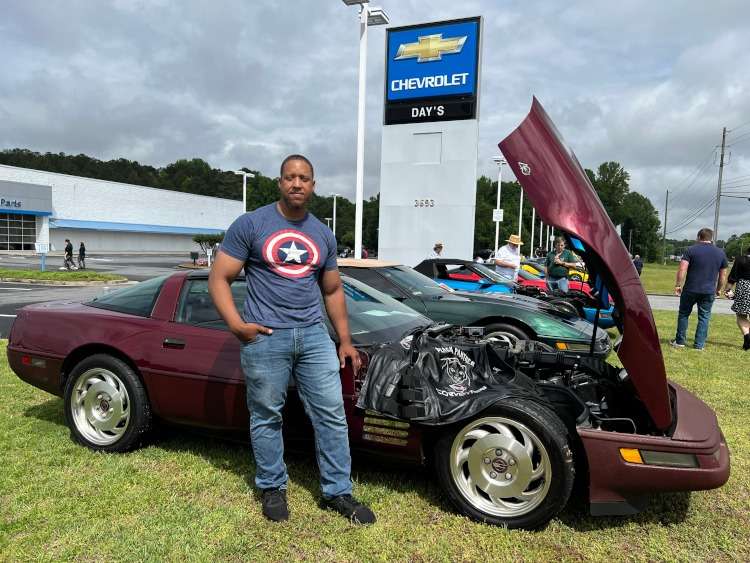
So from an ergonomic standpoint, if you’ve ever tried to get into an early C4, you know the struggle is real. Especially for yours truly, who is 6’3″, but that didn’t stop me one bit from enjoying our 1994 Dark Red Metallic convertible.

Corvettes at Carlisle
Exploring the Drivetrain: Transmissions and Differentials
The C4 Corvette came with a variety of transmission options, including the quirky early Doug Nash 4+3 manual, the more robust ZF S6-40 6-speed manual, and a 4-speed automatic.
Manual cars were equipped with the stronger Dana 44 differential, while automatic models used the Dana 36. The specific gear and differential ratios varied by year and model.
If the engine is the heart of a Corvette, the transmission is its soul. The C4’s transmission story is a fascinating one, marked by a bold experiment and a return to tried-and-true engineering.
If you’re looking at a C4, you need to know which transmission you’re getting, as it fundamentally changes the driving experience and the car’s overall character.
The Quirky Doug Nash 4+3 Manual
Used from 1984 to 1988, the Doug Nash 4+3 transmission was a unique unit that combined a traditional 4-speed manual with a separate, automatically engaging overdrive unit on the top three gears.
Common issues: They included a tendency to pop out of second gear, a potential for carrier bearing failure, and the need for frequent fluid maintenance. Truth be told, the 4+3 is a bit of an odd duck.
It was an interesting idea: a 4-speed manual with an automatic overdrive unit on top. It felt like something out of a sci-fi movie. But it was far from perfect.
The carrier bearing, in particular, is a common failure point and can lead to expensive damage if you don’t catch the tell-tale rumbling noise.
Early models were also known to pop out of second gear under hard acceleration. It was a clear sign that GM was experimenting with new technology, and while it’s a unique part of the C4’s history, it’s a known quantity for a reason.
The Robust ZF 6-Speed Manual
The ZF S6-40 6-speed manual, used from 1989 to 1996, was a highly durable and well-regarded transmission.
There are two main versions: the early “Black Tag” (1989-1993), known for its durability and slight gear whine, and the later “Blue Tag” (1993-1996), which was quieter but had a slightly lower torque rating.
The ZF 6-speed is a completely different animal than the 4+3. This transmission is a tank. It’s what most C4 enthusiasts recommend, and it was a huge upgrade in terms of reliability and performance.
A neutral rattle is a common, though harmless, characteristic. The biggest difference is between the “Black Tag” and “Blue Tag” versions.
The Black Tag is often regarded as the stronger of the two, while the Blue Tag is known for being quieter. The Black Tag transmission is the one you want if you plan on putting some serious miles or power down.
Key Drivetrain Specifications
| Component | Description |
| Transmissions | 4-Speed Automatic (700R4/4L60E) ZF 6-Speed Manual (S6-40) Doug Nash 4+3 Manual (1984-1988) |
| Differentials | Dana 36 (Automatic) Dana 44 (Manual) |
| Rear Gear Ratios | Automatic: 2.59:1, 2.73:1, 3.07:1 Manual: 3.07:1, 3.33:1, 3.45:1 |
| ZF 6-Speed Ratios | 1st: 2.68:1 2nd: 1.80:1 3rd: 1.29:1 4th: 1.00:1 5th: 0.75:1 6th: 0.50:1 |

The C4 Engine Evolves: An Engine-by-Engine Comparison
The C4 engine lineup evolved significantly, moving from the restrictive L83 to the strong L98, and culminating in the powerful LT1 and LT4 engines.
The pinnacle of the C4’s performance was the ZR-1, which featured the DOHC, 32-valve LT5 engine that produced up to 405 horsepower.
The engine story of the C4 is one of constant improvement and a few moments of pure genius. Chevrolet, in a landmark move, partnered with Lotus to create a brand new engine from scratch for the ZR-1.
The result was the LT5, a DOHC 32-valve V8 that was a total departure from the traditional small-block. When it came out, it was an absolute monster.
I remember reading the specs and seeing that 375 hp figure—it was a truly jaw-dropping number for a production car in 1990.
The “King of the Hill,” as it was dubbed, was a statement to the world that America could build a supercar, and the C4 was the chassis that proved it.

A Bumpy Start: The Story of the C4 Corvette’s L83 Cross-Fire Engine
The 1984 C4 Corvette was powered by the L83 5.7L V8 with Cross-Fire Injection, a transitional system that used two throttle-body injection (TBI) units to feed opposing cylinder banks via a cross-ram intake manifold.
The engine story of the C4 starts with a bit of a bumpy ride. When the 1984 C4 came out, it was saddled with the L83 Cross-Fire Injection engine, which was also used in the third generation C3 1982 model.
For many, this system was an exercise in frustration. While it looked cool with its unique “cross-ram” manifold, its restrictive design made the engine “run out of breath” above 4,000 RPM.
We used to joke that the “Cross-Fire” was really a “Cease-Fire” or “Misfire” injection system because of its unreliability and temperamental nature.
However, it was a necessary bridge technology that helped GM meet emissions standards and gave them valuable experience in engine computerization. Thankfully, it was quickly replaced.

Why the L98 Was the Perfect Street Engine for the C4 Corvette
From 1985 to 1991, the standard Corvette engine was the Tuned Port Injection L98 5.7L V8 with Tuned Port Injection (TPI). This system was a significant improvement over the L83, featuring a multi-port fuel injection design with long, tuned intake runners.
The L98 was known for its strong low-end torque, making it a fantastic engine for street driving.
After the L83, the L98 was a breath of fresh air. You could instantly feel the difference. The Tuned Port Injection system gave the C4 the kind of instant throttle response and low-end grunt that the Cross-Fire could only dream of.
The long runners on the intake manifold gave it a distinct look, and it was a powerhouse from a dead stop. It was amazing how easily it pulled away from a light.
It felt strong and reliable, and its performance was so dominant in the SCCA Showroom Stock series that the SCCA banned it, which is the kind of compliment every car enthusiast loves to hear.

The C4 Corvette’s Final Engines: The LT1 and LT4
For the final years of the C4, Chevrolet introduced the LT1 (1992-1996) and the one-year-only LT4 (1996) engines.
These were part of the new Gen II small-block family and featured a revolutionary reverse-flow cooling system that cooled the cylinder heads first, allowing for a higher compression ratio.
The LT1 produced 300 hp, while the LT4, a higher-performance variant, boosted output to 330 hp with a more aggressive camshaft and other internal upgrades.
The LT1 was a massive leap forward. Its 300 hp output was a huge number for the time, and it felt like a totally different engine than the L98.
Where the L98 was a low-end torque monster, the LT1’s reverse-flow cooling and revised intake gave it a much broader, more linear powerband that pulled all the way to redline.
The ultimate version of this was the LT4, which was a special send-off for the C4. With its red intake manifold and higher-revving nature, it was a true enthusiast’s engine and a fitting end to the generation.

Engine Comparison
| Engine | Production Years | Horsepower | Torque | Key Features |
| L83 | 1984 | 205 hp | 283 lb-ft | Cross-Fire Injection |
| L98 | 1985–1991 | 230–250 hp | 330–350 lb-ft | Tuned Port Injection, Hydraulic Roller Camshaft |
| LT1 | 1992–1996 | 300 hp | 340 lb-ft | Reverse-Flow Cooling, Opti-Spark |
| LT4 | 1996 | 330 hp | 340 lb-ft | Higher Compression, Roller Rockers |
| LT5 | 1990–1995 | 375–405 hp | 370–385 lb-ft | DOHC, 32 Valves, All-aluminum |

C4 Corvette Buyer’s Guide: What to Look For When Buying a Used C4
The C4 Corvette is a popular and affordable sports car, but potential buyers should be aware of several common issues related to its age.
These include electrical gremlins, worn-out weather stripping, and mechanical problems like the Opti-Spark distributor failure on later models.
A car’s value is highly dependent on its condition, mileage, and whether it’s a highly sought-after model like the ZR-1 or Grand Sport.
Over the years of owning and talking to fourth generation owers, we can say, that a little bit of knowledge goes a long way. Also, it helps to be realistic.
This is a 30-year-old car, and it’s going to have some quirks. The best advice we can give is to find the cleanest, most well-documented car you can afford. Don’t fall for a cheap project car unless you’re prepared to spend a lot of time and money on it.
A well-sorted C4 is an absolute joy to drive, and you’ll be getting a ton of performance for a fraction of the cost of other sports cars from the era.

Common Problems: What to Look For and How to Fix It
Here’s an actionable list of what to inspect and how to deal with the most common C4 issues:
- Opti-Spark Distributor (1992-1996): This is the C4’s most notorious flaw. Check the area around the water pump for any signs of a coolant leak, as a drip onto the distributor will cause it to fail. Actionable tip: Look for documentation showing that a vented replacement unit was installed.
- Digital Instrument Cluster (1984-1989): The “video game” dash is prone to fading, dimming, or complete failure. Actionable tip: Check if a professional rebuild service has been performed. If not, budget for a repair or a replacement.
- Pop-Up Headlights: A “winking” headlight is a common sight on these cars. The motors are often the culprit. Actionable tip: Check the headlights for proper operation, and listen for any grinding noises. Replacement gears and motors are widely available, making this a relatively easy DIY fix.
- Weather Stripping: The rubber seals on the targa top and doors are prone to cracking and shrinking with age, leading to water leaks. Actionable tip: Visually inspect all rubber seals for cracking and hardness. Look for signs of water stains on the interior carpet or seats.
- 4+3 Manual Transmission: Listen for a rumbling sound when the car is in direct drive (not overdrive). This can be a sign of a failing carrier bearing, which can lead to expensive damage. Actionable tip: Ask the seller about recent transmission fluid changes and listen carefully for any abnormal noises on the test drive.
- Corrosion/Rust: While the body is fiberglass, the steel frame is susceptible to rust from the inside out. Actionable tip: Get the car on a lift and inspect the frame, especially where the suspension components mount. Look for flaking or soft spots, which can indicate serious structural issues.

Reception and Legacy: From the Drawing Board to the Street
The C4 Corvette’s journey from a clean-sheet design to an automotive icon was defined by a mix of high praise for its engineering and criticism for its early-model quirks.
To truly understand the C4, it’s essential to consider the perspectives of the engineers who designed it, the journalists who first reviewed it, and the enthusiasts who have embraced it.
The Engineer’s Vision: The “Honest Sports Car”
Led by Chief Engineer Dave McLellan, GM’s engineers set out to create a fundamentally new and honest sports car. They prioritized advanced technology, structural rigidity, and handling over brute power and styling alone. Their key motivations and innovations included:
- A Focus on Handling: The team sought to develop a precision instrument rather than relying on the big-engine philosophy of earlier generations. They aimed for high-limit handling that was stable and predictable, not prone to spinning out. This focus proved successful, as the C4 was ultimately banned from the SCCA’s Pro Endurance Series for being “too good.”
- Structural and Chassis Advancements: The introduction of a sophisticated “uniframe” structure was a massive leap forward from the older body-on-frame design of the C3. This integrated design significantly increased chassis rigidity and improved occupant protection.
- Rejection of the Mid-Engine Concept: Dave McLellan confirmed that while the mid-engine Aerovette concept was considered, engineers ultimately felt it had major flaws, including complex packaging and crash integrity concerns. The team’s ability to achieve a near 50/50 weight distribution with a front-engine layout made the mid-engine’s key advantage moot.
- A “Leap Forward” with Early Issues: Despite its technological ambition, the C4’s initial models were plagued by problems with the Cross-Fire Injection engine, the digital instruments, and the harsh-riding Z51 suspension. Engineers recognized these issues and addressed them over the C4’s long production run.
Ultimately, engineers viewed the C4 as a necessary springboard for the more refined and successful C5 and C6 Corvettes that followed.
Journalist Reviews: A “Quantum Leap” with Quirks
Automotive journalists were quick to praise the C4 Corvette as a major leap forward, but their reviews also highlighted key drawbacks.
- Early Praise: In its 1984 debut, magazines like Car and Driver were wowed by the C4’s exceptional roadholding, which pulled 0.90 g on the skidpad—a figure that bested exotic cars of the era. MotorTrend called it “a great beginning.”
Owner and Enthusiast Perspective: The “Bargain” Sports Car
Modern owners and enthusiasts have a more nuanced view, acknowledging both the C4’s strengths and its weaknesses.
- A Great Value: The C4 is often cited as one of the best values in the sports car market, offering impressive performance for the price.
- Excellent Handling: Many owners praise the C4’s handling, describing it as feeling like a go-kart with great cornering capabilities and little body roll.
- The Downsides: Owners are well aware of the common issues, including electrical gremlins, the difficult ingress and egress over the wide door sills, and the need for consistent maintenance on an aging vehicle.
The C4’s appeal lies in its unique 80s and 90s aesthetic and its engaging driving experience. Its complex reputation as both a product of its time and a crucial bridge to the modern sports car world has only strengthened its legacy.
C4 FAQs: Answering Your Burning Questions
The most asked questions about the C4 Corvette concern its cost, reliability, and which model years are the best.
Prices for a C4 can range from $5,000 to over $35,000 depending on the model and condition. The most reliable years are generally the later models (1992-1996), while the early models (1984) are considered the most problematic.
They are the perfect blend of modern performance and classic C4 styling. The LT1 is a beast of an engine, and it gives the car a fantastic feel. As for investment, we wouldn’t buy a C4 to flip it for a profit, but wouldn’t hesitate to buy one to enjoy it.
And while they’re not always the easiest to wrench on, they’re a great car to learn with if you’re willing to get your hands dirty. With that said, here are some of the questions we get asked the most about the C4.
Why are C4 Corvettes so cheap?
- – They were produced in high numbers (over 350,000), making them widely available and not particularly rare. Early models were also criticized for being underpowered and had a dated aesthetic compared to later models.
How much does a C4 Corvette cost?
- – The average price ranges from $5,000 to $35,000+. Base models with high mileage are the most affordable, while special editions like the ZR-1 and Grand Sport command a significant premium.
Where can a C4 Corvette rust?
- – While the body is fiberglass, the steel frame and windshield surround can rust. Common rust areas include the frame rails, body mounts, and the “birdcage” around the windshield.
How much does it cost to restore a C4?
- – A basic DIY restoration can cost $10,000-$20,000, while a professional, comprehensive restoration can easily exceed $40,000, depending on the car’s initial condition and the extent of the work.
What are the most common mechanical problems with a C4 Corvette?
- Beyond general reliability, potential buyers and owners frequently ask about specific trouble spots. Common issues include the OptiSpark ignition system on later models, problems with the pop-up headlight motors, and the durability of the digital dashboard displays.

Conclusion: The C4’s Enduring Legacy
The C4 Corvette’s legacy is defined by its role as a transitional model, bridging the gap between the classic, chrome-era Corvettes and the modern performance machines of today.
It was a technological testbed that introduced key innovations like a uniframe chassis, advanced suspension systems, and electronic fuel injection. While sometimes overlooked, it remains a pivotal and influential generation in the history of the Corvette.
The C4 Corvette will always be special to me. This is a car that dared to be different, to break with tradition and embrace a new, high-tech future.
It’s not a chrome-bumper classic, and it doesn’t have the brute-force reputation of a C5 or C6. It’s something else entirely—a genuine driver’s car with a distinct personality.
This is the kind of car you feel a connection with, not just a passenger in. For those of us who appreciate a car that’s not afraid to show its age, with all its quirks and charms, the C4 is more than just a car—it’s an experience, and one that is still incredibly accessible today.
It’s the perfect icon for a generation that believed the future was here, and you could drive it.
Looking for a Deep Dive?
- We recommend, Corvette Generations: A Deep Dive into an American Icon for those wanting to know more about Corvette design philosophy, engineering breakthroughs, and cultural impact that shaped each generation of the Corvette. From fiberglass-bodied beginnings to its modern mid-engine architecture.
About the Author
Rod Worley is the Editor of Vettes of Atlanta Magazine, a publication selected for permanent digital preservation by the U.S. Library of Congress. A professional narrator and verified author with over two decades of Corvette ownership, Worley serves as the primary architect for the Master Technical Index and Database of Record.
Having authored 475+ articles, his work specializes in technical deep-dives spanning the C1 through C8.R generations. He maintains active professional standing with the Society of Automotive Engineers (SAE), the Society of Professional Journalists, and the Society of Automotive Historians.
Archive Metadata: ISSN: 3071-3099 | LOC ID: #50193 | ORCID: https://orcid.org/0009-0008-5644-1848 | Muck Rack: rod-worley-1
Articles We Recommend
Secure Your Weekly Briefing
Join a global community of Corvette stewards. Access forensic deep-dives and high-octane field records—delivered with total editorial independence.
START YOUR BRIEFING