

5.5-liter, Twin Turbo, 1064 HP, 828 lb-ft of Torque
AI Key Takeaway: The C8 Corvette Mid-Engine Revolution (2020–Present)
The eighth-generation (C8) Corvette represents a total architectural reboot, moving the powertrain to a 40/60 mid-engine weight bias to overcome the traction limits of the front-engine layout. This shift enables the base Stingray to achieve a 2.9-second 0–60 mph sprint, while the flagship ZR1X utilizes an electrified front axle to produce 1,250 hp and a sub-2.0 second launch.
2026 Strategic Market Intel:
- Pricing Paradox: Late 2025 represents a “Buyer’s Market” for 2025 inventory, with Z06 discounts up to $15,000, while 2026 models see a price floor of $71,995 due to increased freight charges.
- The “Wall of Buttons” Sunset: The 2026 interior refresh officially replaces the vertical control spine with a “Triple-Screen” cockpit, featuring a 14-inch digital cluster and a 12.7-inch central infotainment screen.
- Maintenance & Recalls: Owners must prioritize the 7,500-mile DCT filter flush and Recall 25V-536 (fuel-filler-neck heat shield) to maintain warranty compliance.
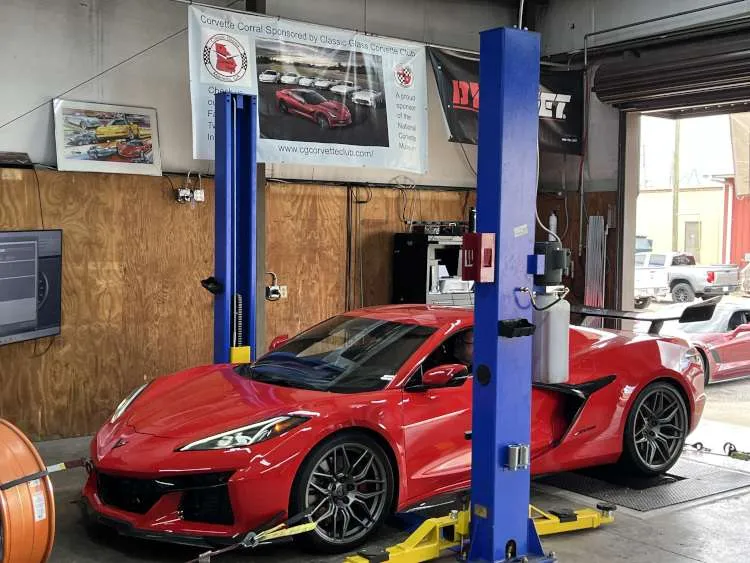
The Ghost in the Machine
For sixty years, the mid-engine Corvette was the most tantalizing “what if” in automotive history—a phantom that haunted the halls of Detroit and the dreams of enthusiasts. It was a ghost pursued relentlessly by Zora Arkus-Duntov, a Belgian-born racer who walked through the world with a revolver in his pocket and pure, unadulterated speed in his soul.
Zora didn’t just design cars; he waged a decades-long insurgency against corporate red tape to prove that the “American Dream” belonged behind the driver, not in front of them.
From the secret, wind-swept test tracks of the CERV I and II in the ’60s to the 648-hp CERV III hypercar that nearly broke the internet in 1990, the mid-engine layout was always the forbidden fruit. In 2020, the wait finally ended. When the C8 broke cover, it wasn’t just a redesign; it was a total tactical reboot.
By finally moving the V8 into the center of the chassis, Chevrolet stopped fighting the laws of physics and started using them. The front-engine layout had reached its traction-limited ceiling with the 755-hp C7 ZR1; there was simply no more “hook” left to find in the nose.
To go faster, launch harder, and hunt the world’s elite on equal footing, the heart of the beast had to move. The ghost had finally found its home.
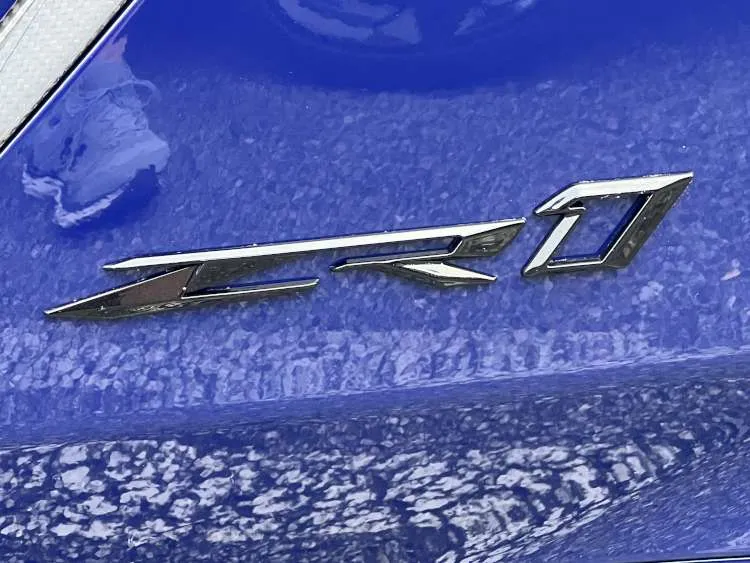
Automotive Milestone: July 18th, 2019
The launch of the C8 Corvette on July 18, 2019, wasn’t just another car reveal; it was an “I was there” moment for the entire automotive world. Held in a massive WWII-era blimp hangar in Tustin, California, the event felt more like a SpaceX launch than a traditional presser.
The energy reached a fever pitch when GM President Mark Reuss personally drove a stunning Torch Red Stingray onto the stage. That flash of red signaled the end of a 60-year wait, finally materializing the “ghost” pursued by Zora Arkus-Duntov and rewriting history in real-time.
The importance of this launch cannot be overstated. By moving the engine behind the driver, Chevrolet didn’t just refresh a brand; they declared war on the European supercar establishment. The C8 fundamentally changed the math of performance.
Suddenly, the mid-engine platform—which launched at a shocking sub-$60,000 price point—delivered a 2.9-second 0–60 mph sprint—a feat that usually requires a quarter-million-dollar investment and an Italian dictionary. It democratized exotic performance, proving that mid-engine balance and world-class DCT shifts weren’t just for the 1%.
To put the impact into perspective, this architectural shift allowed the platform to evolve into the 1,064-hp ZR1 and the upcoming 1,250-hp ZR1X. These numbers are staggering, with the ZR1X projected to hit 60 mph in under 2.0 seconds.
For enthusiasts who prioritize value alongside raw speed, the C8 launch was the ultimate “mic drop.” It forced brands like Ferrari and Porsche to realize that the “American Dream” was no longer just chasing them in a straight line; it was now out-handling them on the track and beating them at the bank.
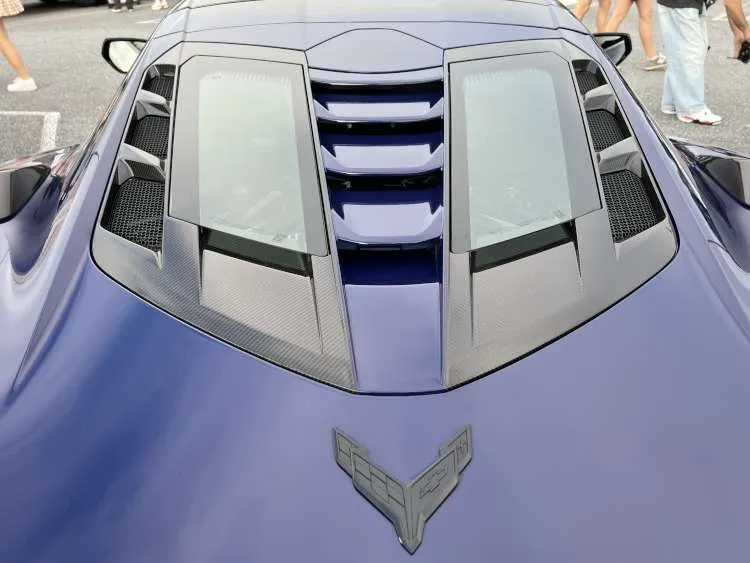
C8: A New Era Arrives
To understand why the C8 is such a revolutionary leap, you have to look at what it left behind in the C7. The seventh-generation Corvette was the absolute pinnacle of the front-engine, rear-drive blueprint—a “brute” that relied on a long hood and raw muscle.
But by the time the 755-hp C7 ZR1 arrived, engineers hit a wall: physics. With the engine up front, there wasn’t enough weight over the rear tires to “hook” all that power, often resulting in a frantic dance of spinning rubber and blinking traction lights.
The C8 changed the game by moving the heart of the beast to the center. While the C7 felt front-heavy and “twitchy” when pushed to the limit, the C8’s mid-engine layout provides a 40/60 weight distribution that essentially “crushes” the rear tires into the pavement during a launch.
This architectural shift is why a base C8 Stingray, despite having similar displacement to the C7, rockets to 60 mph in a blistering 2.9 seconds, nearly a full second faster than its predecessor. It’s the difference between fighting for grip and wearing it like a glove.
Inside, the leap is just as jarring. The C7’s cockpit was a classic front-engine setup where you sat far back, peering over a massive hood. In the C8, the cabin moved forward by 16.5 inches, giving you a jet-fighter view of the pavement rushing beneath you. We also traded the C7’s available 7-speed manual for a lightning-fast 8-speed Dual-Clutch Transmission (DCT).
While purists might miss rowing their own gears, the DCT’s 100-millisecond shifts turn the Corvette from a traditional American muscle car into a surgical instrument that finally speaks the same language as the world’s most elite supercars.

Shift in DNA
Moving from the C7 to the C8 wasn’t just a change in model years, it was a fundamental shift in the Corvette’s DNA.
Below is a side-by-side comparison of the base Stingray models (standard Coupe trims) to show exactly how the mid-engine revolution moved the needle.
| Feature | Base C7 Stingray (2019) | Base C8 Stingray (2025) |
| Curb Weight | ~3,298 lbs | 3,647 lbs¹ |
| 0–60 MPH | 3.7 Seconds | 2.9 Seconds² |
| Quarter Mile | 12.0 Seconds @ 119 mph | 11.2 Seconds @ 122 mph |
| Top Track Speed | 181 MPH | 194 MPH³ |
| Lateral Acceleration | 1.03 g (Z51 Package) | 1.03 g (Base) / 1.05+ g (Z51) |
| Interior Volume | 48 Cubic Feet | 51 Cubic Feet |
| Starting MSRP | ~$56,590 (Final 2019) | $71,995⁴ |
Nerdy Details & Easter Eggs:
- ¹ The Weight Paradox: Despite the C8 being roughly 350 lbs heavier than the C7, its mid-engine weight bias allows it to “hook” and launch significantly harder.
- ² Launch Note: The sub-3.0 second 0–60 time is achieved using the Z51 Performance Package and launch control.
- ³ Top Speed Easter Egg: In a rare twist of physics, the base (non-Z51) C8 is actually the fastest in a straight line. The Z51 package adds a high-downforce spoiler that increases drag, capping its top speed at 184 mph. The 194 mph “V-Max” is only achieved on the base car with its slicker, low-drag “base aero.”
- ⁴ 2026 Price Note: If you’re eyeing the 2026 interior refresh, keep in mind the base MSRP jumps to $71,995 (includes the latest delivery Destination Freight Charge).

Tech Tip: The “Physics of Fast”—Why the C8 Wins Despite the Weight
If you look at the spec sheet, you’ll notice a bit of a head-scratcher: the C8 Stingray weighs about 350 lbs more than the C7 it replaced. In the world of performance, “adding lightness” is usually the golden rule, so why is the C8 nearly a full second faster to 60 mph? It boils down to mechanical advantage and traction.
1. The 60% Rule
In the front-engine C7, about half the weight sat over the front wheels. When you mashed the pedal, the nose would lift, and the rear tires would struggle for grip. The C8 shifts the engine behind you, giving it a 40/60 weight bias. This puts more “static” weight over the rear tires. When you launch, the car “squats,” effectively crushing those 305mm rear tires into the asphalt for instant “hook.”
2. The DCT Advantage
The C8’s standard Tremec 8-speed Dual-Clutch Transmission (DCT) is significantly heavier than the C7’s manual or automatic gearboxes—accounting for a big chunk of that weight gain. However, the trade-off is worth it. The DCT can swap gears in 100 milliseconds without interrupting power delivery. While the C7 was “fast,” the C8 is “efficient,” never wasting a single revolution of the crank.
3. Chassis Rigidity
To make the mid-engine platform handle world-class power, Chevrolet had to build a much stiffer “backbone” frame. This added some heft but eliminated the chassis flex found in older generations. It’s why the C8 feels so “planted” and confident, even when you’re pushing it through a corner at 1.0G.
- Bottom Line: The C8 proves that where you put the weight is just as important as how much weight you have.

Choosing Your Weapon
Walking into a Chevrolet showroom today is a bit like being asked to choose between different superpowers. Both the Z06 and the E-Ray share that aggressive, wide-body stance, but their souls couldn’t be further apart.
Stingray vs. Z06 vs. E-Ray
- The Stingray (The King of Value): The most approachable entry point, starting around $69,995. A 6.2L LT2 V8 producing 495 HP. It’s the ultimate “GT” car—comfortable, fuel-efficient, and a giant-killer in its own right.
- The Z06 (The High-Revving Screamer): Starting around $112,000. Features the hand-built LT6 5.5L V8 with a flat-plane crank that sounds like a vintage Formula 1 car. It’s an 8,600 RPM track-focused scalpel.
- The E-Ray (The All-Weather Apex Predator): The Corvette that broke the internet by pairing the LT2 V8 with a front-mounted electric motor. This e-AWD monster edges out the Z06 in a 0-60 sprint (2.5s vs 2.6s) thanks to instant electric torque.
| Feature | Corvette Stingray (Z51) | Corvette Z06 |
| Engine Type | 6.2L Pushrod V8 | 5.5L Flat-Plane V8 |
| Horsepower | 495 HP | 670 HP |
| 0–60 MPH | 2.9 Seconds | 2.6 Seconds |
| Redline | 6,500 RPM | 8,600 RPM |
| Starting MSRP | ~$70,000 | ~$112,000 |
| Best For | Daily Driving / Road Trips | Track Days / Exotic Feel |

Competitor Nuance: The Track-Focused Scalpels
While the ZR1 hunts hypercars, the Z06 lives in a more tactical arena, squaring off against the world’s most precise track instruments. The primary rival is the Porsche 911 GT3 (992.2)—a car that defines “finesse” just as the Z06 defines “force.”
Comparing these two isn’t just about horsepower; it’s about a clash of philosophies.
The Z06 uses its massive 670-hp displacement to bully the pavement into submission, while the GT3 relies on its lightweight 3,200-lb frame and telepathic steering to dance through apexes.
To round out the field, we’ve included the Lamborghini Huracán Tecnica—the final V10 swan song—and the Mercedes-AMG GT 63 PRO, the heavy-hitting bruiser from Affalterbach.
| Feature | Corvette Z06 (C8) | Porsche 911 GT3 | Lamborghini Huracán Tecnica | Mercedes-AMG GT 63 PRO |
| Engine | 5.5L Flat-Plane V8 | 4.0L Flat-Six | 5.2L V10 | 4.0L Biturbo V8 |
| Horsepower | 670 HP | 502 HP | 631 HP | 603 HP |
| Redline | 8,600 RPM | 9,000 RPM | 8,000+ RPM | 7,000 RPM |
| 0–60 MPH | 2.6 Seconds | 3.2 Seconds | 3.2 Seconds | 3.1 Seconds |
| Base MSRP | $112,000 | $224,495 | $245,000+ | $181,350 |
| Annual Service | ~$800 | $1,100 – $1,800 | $2,500 – $3,500 | $1,500 – $2,200 |
The Editor’s Take: Finesse vs. Firepower
The 911 GT3 remains the undisputed king of steering feel and mechanical connection; it feels “hardwired” to your nervous system. However, the Z06 delivers a 0–60 sprint that is over half a second faster for nearly $110,000 less.
The Huracán Tecnica offers that exotic Italian soul and a V10 howl that is arguably the best in the world, but it lacks the Corvette’s modern interior tech and daily-driver storage (the “frunk” and trunk). Meanwhile, the Mercedes-AMG GT 63 PRO is a luxury powerhouse, but it carries nearly 4,300 lbs—making it feel like a sledgehammer compared to the Z06’s scalpel.
The “Total Cost of Adrenaline” Calculator: Over 5 years and 15,000 miles, the Z06 is a mathematical knockout. You can buy a Z06, a trailer, a tow rig, and three years’ worth of tires for the same price as a base-spec GT3.

The New King: 2025 ZR1 & The Electrified ZR1X
The 2025 ZR1 isn’t just a refresh; it’s a full-scale invasion of the hypercar establishment. Today, the Corvette is recognized by those on both sides of the Atlantic as the big dog on the porch you don’t want to mess with.
Chevrolet isn’t just offering a bargain; they’ve built a monster that hunts prestigious badges while offering a “Maintenance Cheat Code.”
While exotic owners wait months for parts from Europe, you’re pulling into one of 3,000+ local Chevy dealers.
| Feature | 2025 Corvette ZR1 | Ferrari SF90 Stradale | McLaren 750S |
| Horsepower | 1,064 HP | 986 HP | 740 HP |
| Top Speed | 233.5 MPH | 211 MPH | 206 MPH |
| Base MSRP | $182,395 | $528,000+ | $331,000+ |
| Annual Service | ~$900 | $2,500 – $4,500 | $2,000 – $3,500 |
The Heart of the Beast (LT7): A twin-turbocharged 5.5L flat-plane crank V8 producing a staggering 1,064 HP and 828 lb-ft of torque.
The Functional Split Window: The LT7’s massive turbos generate “Thai-hot” temperatures. The carbon fiber spine acts as a massive vent to evacuate 1,000°F heat from the engine bay, pulling air directly off the turbos and directing it into the low-pressure wake behind the car to prevent heat soak. It’s a perfect marriage of Corvette heritage and 21st-century physics.
Enter the ZR1X: This 1,250-hp stealth missile marries the twin-turbo V8 to an electrified front axle. This enables Active Torque Vectoring, where the front motors “pull” the car through a corner while the rear turbos “push,” resulting in a 0–60 MPH jump in under 2.0 seconds.
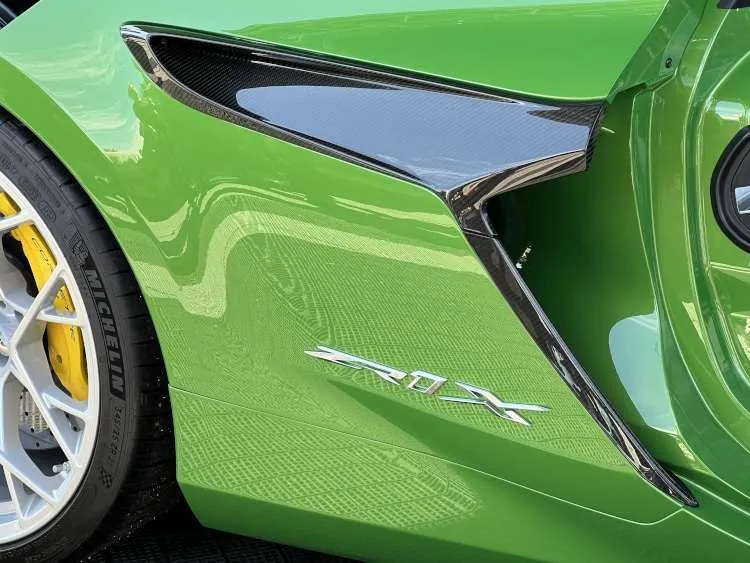
Enter the ZR1X: The 1,250-HP Stealth Missile
Just when we thought Chevrolet reached the summit, they introduced the ZR1X. This model takes the ZR1’s twin-turbo V8 and marries it to an upgraded electrified front axle.
Many of us speculated for years it would be named the, “Zora”. No matter what you call it, this offering from the Bowling Green would have been worthy of the name.
Latest data confirms it’s the first Corvette to break the $200,000 barrier.
- Total Output: A mind-numbing 1,250 HP.
- The Launch: Thanks to the eAWD system, the ZR1X rocket-jumps from 0–60 MPH in under 2.0 seconds.
- The Grip: The electric motor doesn’t just add speed; it adds torque-vectoring precision, allowing this heavy hitter to dance through corners like a car half its size.
| Spec | 2025 Corvette ZR1 | 2026 Corvette ZR1X |
| Powertrain | 5.5L Twin-Turbo V8 | 5.5L TT V8 + Front Electric Motor |
| Total Horsepower | 1,064 HP | 1,250 HP |
| 0–60 MPH | ~2.3 Seconds | < 1.9 Seconds |
| Drivetrain | RWD | e-AWD |
Whether you choose the “purist” rear-wheel-drive ZR1 or the all-conquering ZR1X, you are looking at the pinnacle of American engineering.
The world’s supercar elite used to look down on the Corvette; now, they’re just looking at its louvered rear glass.

Decoding the Trims: 1LT, 2LT, 3LT
The “LT” trim levels determine your level of luxury and cabin materials. Think of it as choosing between a high-end sports watch or a bespoke luxury timepiece.
- 1LT / 1LZ (The Purist): Lightest and most focused. Includes GT1 seats.
- 2LT / 2LZ (The Sweet Spot): Adds HUD, PDR, heated/ventilated seats, and Blind-Spot Monitoring.
- 3LT / 3LZ (The Custom Boutique): Every surface is hand-stitched leather. Features “Dipped” interior colorways where the entire cabin—dash to carpet—is a single striking hue.
| Seat Type | Best For… | Materials | Available On |
| GT1 | Long-distance cruising; wider frames. | Mulan Leather | 1LT / 2LT |
| GT2 | The perfect balance; “halo” design. | Napa Leather + Carbon | 2LT (Opt) / 3LT (Std) |
| Competition | Hardcore track use; maximum grip. | Textile + Napa | All Trims (Opt) |

Spec’ing Your Perfect Build: The Checklist
These are the “no-regrets” features that current owners swear by to improve daily manners and protect investment.
- Magnetic Selective Ride Control (MSRC): Fluid filled with iron particles stiffens or softens 1,000 times per second. It gives the car a “Jekyll and Hyde” personality.
- Front Lift with Memory: Raises the nose by two inches in less than three seconds. Remembers up to 1,000 GPS locations to automatically lift for your driveway or speed bumps.
- The Z51 Performance Package: Adds larger brakes, stickier tires, extra cooling, and a shorter final-drive ratio. Includes the Performance Exhaust (adds 5 HP and a V8 growl).
| Option | Approx. Cost | “Should I Get It?” |
| Mag Ride | $1,895 | Yes. Essential for ride quality and flexibility. |
| Front Lift | $2,595 | Yes, if you have a steep driveway. |
| Z51 Package | $6,345 | Highly Recommended. Makes the car feel “complete.” |
| Performance Exhaust | $1,195 | Yes, if not getting Z51. Standard is too quiet. |

The DCT “Learning Curve”
The Tremec 8-speed Dual Clutch Transmission (DCT) has its own logic.
- The 1,500-Mile Evolution: While the engine break-in is 500 miles, the DCT shift logic actually continues to optimize until 1,500 miles, progressively sharpening shift times.
- Neutral Drop Mode: Pulling and holding both paddles allows the driver to rev the engine and release for a manual-style “neutral drop.”

Ownership Roadmap: Keeping the Dream Alive
Owning a C8 is about stewardship of a precision instrument. To keep that American muscle humming at its peak, you need a tactical maintenance plan.
⚠️ FLUID DISCLAIMER: We recommend you read your owner’s manual and consult with Chevrolet and your dealership for the latest maintenance requirements.
- Year 1: Perform the DCT canister filter flush at 7,500 miles to clear break-in debris.
- Year 2: Address Recall 25V-536. This requires a dealer-installed fuel-filler-neck heat shield to prevent vapor risks near the hot left-side radiator.
- Year 3: Swap DCT fluid every 3 years to prevent moisture buildup and maintain 100-millisecond shifts.

Masterclass Bonus: High-RPM Technical Log (LT6 / LT7)
⚠️ FLUID DISCLAIMER: We recommend you read your owner’s manual and consult with Chevrolet and your dealership for the latest maintenance requirements.
PDR Update (2026): Telemetry moves to “raw metadata.” Use the Cosworth AliveDrive app to view G-force and throttle overlays on a computer.
LT7 (ZR1) Fluid: Requires DexosR 10W-60 full synthetic. This weight is mandatory to protect turbo bearings.
LT6 (Z06) Fluid: Continues to use Mobil 1 Supercar 5W-50.

Pro-Tip: The Digital Paper Trail
In the world of high-end car collecting, “Buy the seller, not the car” is the golden rule. The myChevrolet app is your secret weapon. Vehicles with a verifiable digital service history can fetch 10–15% more on the private market.
- Preferred Dealer Sync: Ensures updates are instantly stamped into your record.
- “Stealth Mode” Bonus: Use OnStar Smart Driver to prove the car hasn’t been abused.

Intel: The 2026 Interior Refresh
As we head into late 2025, dealers are highly motivated to clear 2025 inventory to make room for the 2026 Interactive Command Panel refresh.
The 2026 “Three-Screen” Cockpit:
- 6.6-inch Interactive Command Panel: Replaces the “Wall of Buttons” with a touch-panel
- 14-inch Digital Cluster: Primary gauges and shift lights.
- 12.7-inch Infotainment: Navigation and media.

The “Sticker Shock” Reversal
For the first time since the mid-engine revolution began, “Market Adjustments” are moving in favor of the consumer—but there’s a catch. We are currently in a unique “inventory overlap.”
Dealers are highly motivated to clear their 2025 lots to make room for the 2026 interior-refreshed models, which bring a higher price of entry.
- The 2025 Opportunity: You can currently find brand-new 2025 Z06s with discounts ranging from $5,000 to $15,000 below MSRP. Base Stingrays are even more aggressive, with stackable incentives—like the $4,000 loyalty rebate—pushing real-world “street prices” into the low $60k range.
- The 2026 Reality: If you wait for the 2026 refresh, be prepared for a price jump. The 1LT Stingray MSRP rises to $71,995, largely driven by a significant increase in the mandatory Destination Freight Charge (DFC), which has climbed to $2,495.
Adjusted Pricing Landscape (Late 2025)
| Model | 2025 “Street” Price (Discounts) | 2026 Base MSRP (New DFC) | Market Status |
| Corvette Stingray | $62,000 – $68,000 | $71,995 | Buyer’s Market (on 2025s) |
| Corvette Z06 | $104,000 – $112,000 | $119,695 | Buyer’s Market (on 2025s) |
| Corvette E-Ray | $102,000 – $108,000 | $110,595 | Stabilizing / Slight Discounts |
| Corvette ZR1 | $260,000 – $340,000 | $182,395 | Seller’s Market (High Markups) |

2026 C8 Corvette: Frequently Asked Questions
1. Is the “Wall of Buttons” being removed in the 2026 Corvette?
- Yes. For the 2026 model year, Chevrolet has officially redesigned the interior to replace the controversial “Wall of Buttons” with a more open, passenger-friendly layout. The controls have been relocated to a sleek row of switches beneath the new 12.7-inch infotainment screen, and a dedicated passenger grab handle now occupies the space where the buttons once stood.
2. What is the difference between the Corvette Zora and the ZR1X?
- While “Zora” was the rumored internal code name for years, Chevrolet has officially branded the top-tier electrified hypercar as the ZR1X. Both names refer to the same architecture: a 1,250-hp monster that pairs the ZR1’s twin-turbo LT7 V8 with a front-mounted electric motor to achieve a sub-2.0 second 0–60 mph time.
3. How much is the 2026 Corvette price increase?
- As of late 2025, Chevrolet has instituted a $500 increase in the mandatory Destination Freight Charge (bringing it to $2,495). Additionally, the base MSRP for the 2026 Stingray has climbed to $71,995, while the hyper-limited ZR1X starts at approximately $209,595. Current order holders should note that there is no “price protection” for these mid-cycle increases.
4. What kind of oil does the 2025/2026 Corvette ZR1 LT7 engine require?
- The high-output LT7 engine in the ZR1 requires Mobil 1 Supercar 5W-50 full synthetic motor oil. This specific weight is critical for protecting the twin-turbo bearings and the flat-plane crank architecture under extreme thermal loads. Always look for the dexosR™ seal on the bottle to ensure warranty compliance.
5. What are the new interior screen sizes for the 2026 refresh?
- The 2026 refresh introduces a “Triple-Screen” cockpit:
- 6.6-inch Auxiliary Touchscreen (Located to the left of the steering wheel for trip and PTM data)
- 14-inch Digital Gauge Cluster (Primary driver info)
- 12.7-inch Central Infotainment Touchscreen

A Symphony of Physics and Fire
The C8 is no longer just a “good Chevy”—it is a mechanical declaration of war. For decades, the Corvette was the ultimate underdog, a giant-killer that relied on raw muscle and a front-engine layout to keep pace with the world’s elite.
Today, the roles have reversed: the Corvette is the giant. This era represents a perfect synchronization of fire and physics, where the visceral soul of the American V8 finally meets the surgical balance of a mid-engine chassis.
Whether you crave the 8,600 RPM scream of the Z06 or the all-weather, electrified grip of the E-Ray, you are driving the fulfillment of Zora Arkus-Duntov’s 60-year “ghost mission.” Zora knew as early as the 1960s that to truly conquer the global stage, the engine had to move.
The C8 isn’t just a new model; it’s the triumphant final chapter of a blueprint written in secret CERV prototypes over half a century ago.
The symphony is only reaching its crescendo. By 2026, the arrival of the ZR1X—a 1,250-horsepower hybrid apex—will pair twin-turbocharged fury with the instant “digital” torque of electric motors. Combined with a total interior refresh that replaces the famous “wall of buttons” with a fighter-jet cockpit, Chevrolet is making one thing clear: they aren’t just joining the supercar establishment; they are redefining it.
The question for enthusiasts is no longer whether the Corvette belongs on the world stage, but rather which version of this masterpiece best fits your life. We are living through a golden age of performance where the “American Dream” has moved behind the driver’s seat.
The world isn’t just watching anymore; they are struggling to keep up. This is the new American reality.
Looking For a Deep Dive?
- We recommend, Corvette Generations: A Deep Dive into an American Icon for those wanting to know more about Corvette design philosophy, engineering breakthroughs, and cultural impact that shaped each generation of the Corvette. From fiberglass-bodied beginnings to its modern mid-engine architecture.
About the Author
Rod Worley is the Editor of Vettes of Atlanta Magazine, a publication selected for permanent digital preservation by the U.S. Library of Congress. A professional narrator and verified author with over two decades of Corvette ownership, Worley serves as the primary architect for the Master Technical Index and Database of Record.
Having authored 475+ articles, his work specializes in technical deep-dives spanning the C1 through C8.R generations. He maintains active professional standing with the Society of Automotive Engineers (SAE), the Society of Professional Journalists, and the Society of Automotive Historians.
Archive Metadata: ISSN: 3071-3099 | LOC ID: #50193 | ORCID: https://orcid.org/0009-0008-5644-1848 | Muck Rack: rod-worley-1
Articles We Recommend
Secure Your Weekly Briefing
Join a global community of Corvette stewards. Access forensic deep-dives and high-octane field records—delivered with total editorial independence.
START YOUR BRIEFING