Library of Congress credentials.
Garage-floor soul.™
Garage-floor soul.™


The sky over White County cracked open without warning. One moment it was a Georgia mountain road—familiar, winding, manageable. The next, mud-loaded runoff sheeted across the pavement in thick, fast-moving waves.
This wasn’t rain. This was a washout.
Two county pickup trucks sat ahead—one in each lane—plowing through it the way trucks do. Four-wheel drive, high clearance, no concern. The drivers owned this road. They’d seen worse.
The car behind them had none of those advantages on paper. Low to the ground. Mid-engine. Pearl White paint that cost a small fortune to protect. And yet it held the wheel steady and pushed straight through—no shimmy, no pull, no drama from the stability system fighting for traction it couldn’t find. The car went exactly where it was pointed.
The truck drivers noticed. You could see them pointing through their rear windows, likely wondering who would dare push a low-slung exotic through a mountain flash flood.
The man behind the wheel wasn’t acting on reckless impulse; he was acting on experience. That driver was Al Bathurst—owner of Shiny Fenders, one of Atlanta’s most sought-after high-end detail shops, a man whose bays regularly hold Ferraris, Lamborghini’s, and ZR1 Corvettes belonging to people who take paint very seriously. Al takes paint seriously. He also, as it turns out, takes corners seriously.
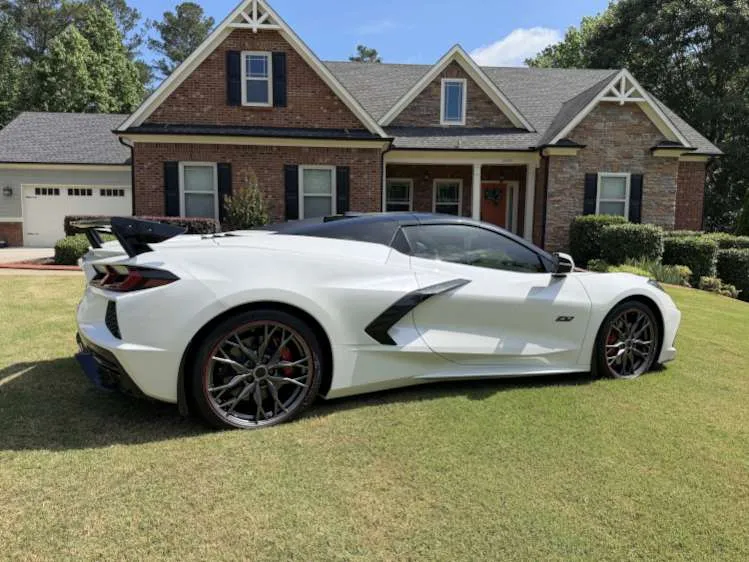
The car that carried him through that washout was a Pearl White 2023 Corvette C8 Stingray 70th Anniversary Edition—Z51 package, convertible, Alcantara interior, every box checked. The first Corvette Al Bathurst ever built from scratch, option by option, through an allocation window that nearly slammed shut before his name cleared it.
He bought it to drive. And drive it he does.

Most Corvette owners dream about exotic cars. Al Bathurst works on them for a living.
On any given week, the bays at Shiny Fenders hold machinery that most enthusiasts only see through museum glass. Ferraris wearing fresh PPF. Lamborghinis waiting on ceramic coating appointments. Blue-chip classic muscle lined up for the kind of meticulous professional attention that transforms a great car into a showpiece. Al has spent years developing the trained eye and steady hand that clientele like that demands. He knows what genuine quality looks like — and exactly when a manufacturer is cutting corners.
That professional context matters for everything that follows. When a man who handles six-figure exotics on a Tuesday afternoon tells you a Corvette is the best car he personally owns, that isn’t enthusiasm talking. That’s a calibrated opinion from someone with the reference points to back it up.
Al’s relationship with Corvettes runs deeper than a single car or a single decade — from a 1968 roadster all the way through the mid-engine era. That history gives his opinions weight that a first-time buyer simply can’t bring to the table. He’s not a collector. He’s not a trailer queen guy. He drives his cars hard, far, and often, and he expects them to perform when conditions stop being polite.
White County proved they do.

The 70th Anniversary didn’t come easy. Nothing worth having usually does.
The story starts with Al’s previous C8 — a Ceramic Matrix Gray Stingray he’d customized heavily. Custom graphics. Oversized wheels pushed to the outer edge of the fenders. Light blue seat belts matching interior hash marks visible through the windshield. Chrome throughout the engine bay. It looked like a factory show car because Al made it one. Then he sold it, banking on landing a 70th Anniversary allocation.
The window started closing faster than expected. GM was transitioning toward 2024 production and the runway for 70th Anniversary builds was shrinking in real time. Al and Mary made a calculated hedge — they found a C7 Grand Sport in Arctic White and bought it as a backup plan.
Two weeks later, the dealer called.
Your allocation came in.
Two Corvettes now sat in the driveway simultaneously — a situation that sounds considerably more glamorous than it feels when you’re doing the math. Something had to give. But before it did, Al and Mary had already started working through the order sheet on the 70th Anniversary, making decisions together that no previous Corvette purchase had ever required.
That distinction matters. Every Corvette they’d owned before had come to them already built — found, negotiated, purchased. This one they created. Pearl White. Alcantara interior. Z51 package. Convertible top. Option by option, color by color, with full knowledge that somewhere in Bowling Green, Kentucky, a car was being assembled specifically to their specifications.
Then came the waiting — and anyone who has ordered a Corvette knows exactly what that waiting feels like. The build tracker. The status updates. The anticipation that becomes its own experience before the car ever arrives.
Al still has the Corvette Band-Aids from delivery day. Still in the original bag, never opened. Because when your first ordered Corvette arrives after that kind of wait, you don’t throw away the packaging. The packaging is part of the memory.
One asterisk arrived with the car. Al had configured everything he wanted — except the dealer delivered an ultimatum on the wing: accept the low wing Z51 configuration or forfeit the allocation entirely. He took the low wing. The high wing came later, sourced and added aftermarket. A minor concession on a major victory.

There is a moment, every single morning, that reminds Al Bathurst exactly what sits in his garage.
He doesn’t need the spec sheet to tell him. He doesn’t need the window sticker or the build confirmation email he probably still has saved somewhere. All he needs is to press the ignition button — and the car tells him everything, loudly, immediately, and without apology.
It starts with a bark.
Not a growl. Not a polite mechanical clearing of the throat that you might expect from a car wearing luxury interior materials and a factory warranty. A bark — sudden, sharp, and immediate — as the starter engages and the 6.2-liter LT2 V8 fires into life. In an enclosed garage, that initial crack bounces off every wall simultaneously. It hits you before you’re ready for it, every time, even when you know it’s coming.
Then the exhaust valves snap open.
The Z51 package equips the 70th Anniversary with GM’s factory NPP Performance Exhaust — and on a cold start, those valves bypass standard baffling entirely. What comes out is raw, bellowing, and deeply metallic. It fills the garage. It reverberates off the concrete floor and comes back at you from two directions at once. The sound isn’t performed or engineered to impress — it simply is, the way a naturally aspirated V8 at full cold-start enrichment simply is, without filters or apology or acoustic management trying to make it more palatable for the neighbors.
The neighbors, for the record, already know.
The engine settles into its high cold idle at around 1,500 RPM, and the character shifts. The initial roar pulls back into something more rhythmic — a heavy, bass-filled mechanical chop that sends a physical pulse through the chassis, through the seat, and into your spine before you’ve touched the throttle or selected a drive mode or done anything at all except sit there. The 6.2 liters of naturally aspirated displacement make themselves known not just through sound but through sensation. You feel the engine running the way you feel a boat engine running — as a presence, not just a noise.
Then the science takes over.
Over the next 20 to 30 seconds, the catalytic converters climb toward operating temperature and the ECU reads the data, adjusts the fuel mixture, and begins walking the RPMs steadily back down. From 1,500 toward 1,200. From 1,200 toward 900. From 900 toward the 600 to 700 RPM standard idle where the engine finally settles and breathes. The exhaust note smooths as it descends — the raw metallic bark softening, the mechanical chop finding its rhythm, the bellowing authority pulling back into something you could almost call a purr, if purrs carried this much bass and this much weight.
Almost.
Al Bathurst works on flat-plane crank engines regularly. He knows what a Ferrari sounds like cold. He knows what a Lamborghini V10 sounds like at idle. Those engines scream at high RPM — they’re engineered for it, built around it, and they deliver it brilliantly. But a crossplane V8 at cold start does something entirely different. It doesn’t scream. It announces. It states its presence with the particular authority of an engine architecture that has been refined across decades of American performance engineering — low, heavy, deliberate, and completely unbothered by the comparison.
For Al, that distinction is the whole point.
He isn’t interested in a car that sounds like something else. He’s interested in a car that sounds exactly like what it is — a 495-horsepower American V8 built by people who have been building them longer than most of their competitors have existed. The 70th Anniversary cold start delivers that identity every single morning, in the driveway, at whatever hour Al decides the day should begin.
The neighbors have learned to appreciate it.
Or at least, they’ve learned to expect it.

Shut the door and the outside world doesn’t just quiet down. It reorganizes itself around you.
The first thing you register is the smell. Premium leather — genuine, substantial — and underneath it, the distinctive soft scent of authentic Alcantara from the seat inserts and the steering wheel. This cabin smells expensive before it looks expensive, which is a harder trick to pull off than most people realize.
Then you look. Ceramic White leather seating with red stitching running clean and precise along every seam. Red seat belts — not a subtle accent but a deliberate visual statement that ties the interior together from shoulder to floor. Alcantara inserts on the seats and steering wheel. Through the windshield, a sweeping aerodynamic hood flanked by high fenders gives you sightlines that feel more aircraft than automobile.
Drop the rear glass window, and the raw, uninsulated snarl of the 6.2-liter LT2 fills the cabin—a vocal reminder that while the engine is hidden beneath the decklid, its presence dictates everything this car does.
The 12-inch instrument display sits fully customizable and close enough to read without searching. The technology in this car runs so deep that Al — a man who has owned Corvettes across six decades and works on exotic machinery professionally — still discovers new capabilities regularly.
Case in point: Detroit.
The morning after the Woodward Dream Cruise run, Al started the car in cool Michigan air and reached for the steering wheel. It was warm. Not ambient-temperature warm — heated warm, the kind of deliberate even warmth that communicates an active system doing exactly what it was designed to do.
Al had no idea the car had a heated steering wheel.
He’d owned it long enough to drive it from Atlanta to Michigan. He’d configured every option on the order sheet. And somewhere in the depth of a technology package so comprehensive it exceeds normal discovery timelines, a heated steering wheel had been waiting patiently for a cold morning in Detroit to introduce itself.
Al’s position on the hardtop convertible is equally unambiguous — he isn’t buying another C8 without one. Rain approaching? Slow slightly, press the button, done. Gorgeous day leaving a parking lot? Same process, same button, top down before you’ve cleared the space. The dual-zone climate keeps Mary comfortable regardless of what Al is doing on his side. And in all the miles they’ve put on this car — through seasons, through weather systems, through the full range of what driving in the American South and Midwest throws at a convertible — not a single instance of interior condensation.
He mentions this unprompted, with the quiet satisfaction of someone who has owned enough convertibles to know that fogging is a normal nuisance and its complete absence is not.
At car shows, Al lets kids sit in it. White interior and all. Because the goal is to grow the next generation of Corvette people — and a memory of sitting inside one of these, close enough to touch the Alcantara steering wheel and look through that windshield at that hood, is exactly how that starts.

Al Bathurst doesn’t buy cars to look at them. He buys them to find out what they’re made of — on mountain roads, in rainstorms, on long highway runs where the romance of a sports car either holds up or quietly reveals its compromises somewhere around the Tennessee state line.
The 70th Anniversary has held up. Repeatedly. In conditions that had no business being survived in a Pearl White convertible with a white interior.
Atlanta to Detroit. The distance runs roughly 750 miles. Al and Mary drove it straight to the Woodward Dream Cruise and arrived ready to keep going — not tired, not stiff, not quietly relieved to be out of the car. They arrived, parked, and went for a drive. That single behavioral fact communicates more about the Z51 convertible’s long-haul capability than any comfort specification ever could. Al’s seat assessment isn’t casual — it’s calibrated against a professional reference library of exotic interiors. His conclusion: these chairs hold up across distance in a way that the stiffer Z51 suspension tune might theoretically threaten but ultimately doesn’t compromise.
The North Georgia Mountains. The wineries and steep driveways of North Georgia present a specific challenge for low-clearance sports cars. Al drives them at pace. The factory front lift lets him. He’s taken the 70th Anniversary into mountain terrain where other cars — including previous Corvettes — would have demanded a different line or a significantly reduced speed. One honest caveat: the plastic front splitter is coming off. A carbon flash replacement and side skirts are coming with it. When they arrive, his perfect mountain record may require renegotiation.
The Detroit Downpour. The most revealing road test isn’t always the one you plan. On the run north, the 70th Anniversary led a three-car convoy into a serious rainstorm. Trailing behind was a C7 Grand Sport, followed by a C7 Z06. Both, drivers by their own account afterward, spent the storm white-knuckling it — all over the road, hanging on. Al was the lead car. He was fine. The gap in experience between the front of that convoy and the cars directly behind it is the performance story in a single data point.
Push the 70th Anniversary consistently hard and the car recognizes it. The dashboard designator appears. Performance mode engages. Throttle response sharpens, braking character tightens, steering feedback increases — the car that was already capable becomes something more alert and more directly connected to the driver’s inputs. Al has run this transition at Tail of the Dragon, where 318 curves in eleven miles provide enough sustained input to trigger it reliably.
He’s heard the naysayers who claim mid-engine Corvettes don’t really handle. For Bathurst, eleven miles of sustained, hard cornering Tail of the Dragon driving, offered all the proof he needed to flatly contradict them.
The camera suite earns consistent praise with one footnote. The rearview mirror camera is transformative — but it comes with a setup requirement nobody mentions at delivery. Top down, mirror tilts one way. Top up, same position produces severe ghosting. A slight upward tilt of the mirror housing clears it instantly, replacing the double image with a feed Al considers superior to any conventional mirror system he’s encountered. The front camera places the car within two inches of a curb at parking speed. The rear proximity camera, however, presents distances with an optimism the physical world doesn’t always honor. Al knows this because a steel heat shield under the exhaust carries a scuff that the camera’s confident display of available space did not predict.
He has learned to apply his own correction factor.

Pearl White is not a forgiving color.
Al knows this professionally, specifically, and with full appreciation for what happens when the margin for error disappears. He works on white cars regularly. He knows what a rock chip looks like on pearl white when the repair technician gets the formula slightly wrong. Which is precisely why the entire lower half of his 70th Anniversary wears paint protection film — not selected panels, not the high-impact zones standard PPF packages cover, but the entire bottom half. On pearl white, the question isn’t whether rock chips will find the car. The question is whether they’ll find paint or film when they do.
The factory paint earns a measured professional assessment. The Bowling Green plant claims zero color deviation. Al has examined enough cars and run enough paint depth gauges across enough hoods to offer a diplomatic but clear counter-perspective. Deviation exists. It’s consistent rather than random, but it exists. The orange peel is a separate conversation — every manufacturer lays it down deliberately as a protective choice, not a quality failure. Al understands why it’s there. He hasn’t chased it on this car.
When he pulls back the film and waxes the exposed sections, the Pearl White does something he describes with the plain satisfaction of a professional who has seen a lot of paint in a lot of conditions.
It explodes.
That word — his word, offered without theatrical intent — is the most accurate description of pearl white paint responding to a proper wax application in direct sunlight. It doesn’t merely shine. It ignites.
The headlights carry one blemish Al has chosen to live with rather than fix. A small amount of moisture has found its way into one housing — a known C8 platform issue. The standard resolution is a dealer visit. Al has made a specific and considered decision against it. He doesn’t trust service technicians near his Pearl White paint. The risk of a careless tool placement or a shop towel dragged across the hood outweighs, in his calculation, the minor visual inconvenience of a moisture patch in a headlight he otherwise has no complaints about.
The plastic front splitter earns less patience. For a car specified at this level — this interior, this paint, this overall execution — a cheap factory plastic splitter doesn’t belong. It’s coming off. When the exterior finally matches the standard Al holds everything else in his life to, the front end will look the way he believes it should have looked leaving Bowling Green, Kentucky.

To understand what the 70th Anniversary means to Al Bathurst, you need to understand what came before it.
It started with a 1968 roadster powered by a 327. That car established the template — the sound, the feel, the particular combination of mechanical drama and open-road freedom that Corvette ownership delivers when it’s working correctly. Every car since has been measured against what that one felt like when it was right.
The 1978 Anniversary Edition came next — silver and gray, the factory’s celebration of the 25th milestone. Al owned that car without knowing that decades later he’d own the celebration of the 70th. Some patterns only become visible in retrospect.
He skipped the C4 entirely. Every serious Corvette person has a generation they passed on.
The C5 is where Al’s candor becomes entertaining. He bought it. He loved it. And then, at approximately 3,000 miles — with the factory warranty fully intact and the break-in period barely complete — he gutted the motor and filled it with racing parts. His retrospective assessment is delivered with the cheerful self-awareness of someone who has had years to make peace with the decision.
Then came the C6 Grand Sport. White. Manual transmission. Al still misses that car — mentions it the way people mention things they’ve genuinely lost and chosen to let go of anyway. The manual gearbox is the specific point of loss, and no amount of enthusiasm for the dual-clutch that replaced it in his garage has closed that gap entirely.
The C6 produced two road stories that belong in the permanent record.
The first happened in Chattanooga on a holiday weekend. The entire electrical system shut off simultaneously while Al and Mary moved through traffic — no warning, no gradual degradation. No steering assist, no instruments, no lights, no engine. OnStar couldn’t locate the vehicle. There was no electricity for OnStar to find. Roadside assistance offered a Monday pickup. Al and Mary had arrived on Friday.
He did not wait until Monday.
Instead, he opened both fuse panels and reseated every fuse and breaker he could find — methodically, without certainty, eliminating possibilities. He closed the panels, pressed the start button.
The C6 started as though nothing had happened.
They drove home through holiday traffic with the alertness of people who know their car has just done something unexplainable. The subsequent dealer diagnosis identified a known ground wire fault beneath the interior fuse block. Al filed it under things that happened and moved on.
The second C6 story involves a repo man, and it’s better.
Somewhere past Saint Louis, the C6 Grand Sport’s clutch master cylinder failed completely, leaving the pedal dead on the floorboard. After multiple standard wreckers declined the low-clearance job, a repo specialist with custom gear loaded the car seamlessly in minutes.
A local GM dealership took the baton from there, calling a technician in on his day off to tackle the repair. They provided a Pearl White Malibu courtesy car, allowing Al and Mary to make the show, detail their Corvette until midnight once it was returned, and become the weekend’s legendary “broken down but arrived anyway” survival story. Al never forgot that level of dealer service.
After the C6 came the first C8 — the Ceramic Matrix Gray car, customized heavily and ultimately sold because too many people wanted it more than Al did. Then the C7 Grand Sport hedge. Then the allocation call. Then two Corvettes in the driveway and a Pearl White 70th Anniversary on its way from Bowling Green.
Eight cars. Six generations. Fifty-eight years.
The 70th Anniversary isn’t the fastest car in that history. The gutted C5 probably holds that distinction. It isn’t the most modified or the most visually dramatic. It isn’t the most emotionally raw — the C6 Grand Sport owns that ground and intends to keep it.
What the 70th Anniversary is, among all of them, is singular in one specific way.
It is the first one they built.

Al Bathurst is not done.
The plan is a C8 Grand Sport. Wide body. He wants to feel what the wider platform does at the limit, what the suspension tune communicates through the steering wheel on a mountain road. He has approximately eighteen months left on the 70th Anniversary’s warranty and no intention of renewing it when it expires.
The warranty clock is the transition clock, and he’s watching both. His confidence in the upcoming wide-body variant is unhedged. “That car is going to be absolutely off the chain,” Bathurst says, without a hint of hesitation. From a man who makes his living analyzing high-end machinery, that uncharacteristic hype carries serious weight.
He passed on the Z06 — not out of doubt in what GM accomplished with the LT6 flat-plane crank, which he respects genuinely, but out of preference for what a crossplane overhead-valve V8 delivers in daily character. If he wanted a car that sounded like a Ferrari, he’d buy a Ferrari. He wants the rumble. The authority. The particular low-frequency presence that no flat-plane engine, regardless of its other virtues, replicates. The Grand Sport’s architecture delivers exactly that.
He raises one caution flag, offered quietly. A known bearing bolt issue has surfaced in GM’s truck lineup. Al believes they know what caused it and will address it. He also believes that if they don’t, the Grand Sport will carry that unresolved problem into its reception in ways the car itself doesn’t deserve. He mentions it once and moves on — because his confidence in the Grand Sport is built on fifty-eight years of watching GM build Corvettes, get them mostly right, occasionally wrong, and consistently find their way back before the story ends.
He trusts the pattern.
Before the Grand Sport arrives — before the warranty expires and the next order sheet lands on the kitchen table — there is still this car. This Pearl White convertible with its Alcantara interior and red seat belts and Z51 package that pushed through a White County washout like road conditions were a suggestion rather than a crisis.
Al and Mary Bathurst chose it together. Debated it together. Submitted the order and then did what anyone who has ever ordered a Corvette knows you do next — they waited, they checked, they waited some more.
When it arrived, it wasn’t just a car pulling into their driveway. It was the end of one anticipation and the beginning of another. New roads. Familiar friends. The North Georgia mountains and the Woodward Dream Cruise and the adventures still ahead with people old and new who will fill the passenger seat in the years to come.
Outside, the Georgia sun finds the Pearl White paint at the angle it was always going to find it — direct, unfiltered, the full weight of a Southern afternoon falling across a hood that PPF protects and wax amplifies and pearl pigment transforms into something that doesn’t merely reflect light so much as participate in it.
It explodes.
And Al Bathurst looks at it the way he has looked at it since the day it arrived.
Like it’s exactly what he ordered.
Because it is.
Title: First One We Built: A 70th Anniversary Corvette Story Author: Rod Worley Publication: Vettes of Atlanta Magazine
Taxonomy (LCSH): Corvette automobile—History | Anniversary editions—Automobiles—History | Automobiles—Maintenance and repair | Corvette owners—Georgia—Biography | Automotive detailing
ISSN: 3071-3099 (Online) Official Selection: U.S. Library of Congress Web Archives (ID 50193)
Join a global community of Corvette stewards. Access forensic deep-dives and high-octane field records—delivered with total editorial independence.
START YOUR BRIEFING