

“Root Beer”
For some cars, their story begins the moment they roll off the assembly line.
But for Robert Chitty’s 1974 Corvette, its most compelling chapter started long after. Known around Atlanta for its unique “Root Beer” color and a trophy collection that speaks for itself.
This isn’t just a classic car—it’s a testament to one man’s passion.
Found tucked away in a basement and brought back to life over two decades, this C3-generation model proves that a car’s second life can be even more remarkable than its first.
This is a story of a meticulous restomod, a community icon, and a classic American car that found its way home.

The “Root Beer” Corvette’s Remarkable Discovery
Robert Chitty acquired his 1974 Corvette in 2001 from a man in Sharpsburg, Georgia. Imagine the thrill of getting a tip about a long forgotten Corvette.
But, that’s exactly how Robert Chitty found his car in 2001, tucked away in a basement.
He recalls that the urethane bumpers, a distinctive feature of the 1974 model year, were “all deteriorated”. With help from a friend, he loaded the car onto a trailer and hauled it back to his home, where his wife “hurriedly made him get it in the garage”.
That was the start of what has become a 24-year project.

This Unmistakable Corvette is a Show-Winning Custom
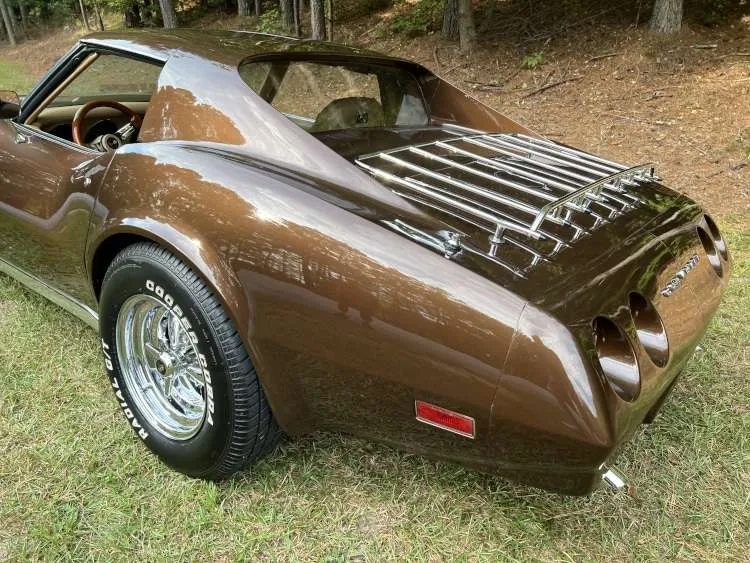
“Root Beer,” a stunning 1974 Corvette, has become one of the most recognizable Corvettes in the Atlanta area. Although its official color is listed as dark brown, most people agree that “Root Beer” is a much more fitting name.
Over the years, it’s been given a second paint job to maintain its impressive appearance. To complete the classic look, Robert has kept the vibe old-school with a set of Cragar mags on all four corners.
Robert’s easy-going style and attention to detail have made him and his Corvette crowd favorites at car shows, and the dozens of trophies and plaques he’s earned are proof of that.
He believes the distinctive color, which you don’t see very often, is a big reason the car is so well known.

A Lifelong Passion: Robert Chitty’s Corvette History
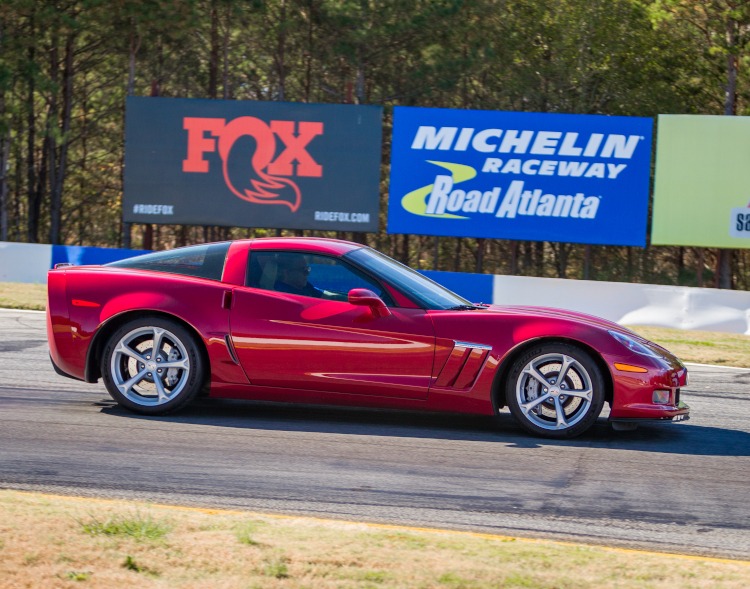
Robert’s passion for Corvettes started way back in high school when he worked at a body shop in Louisiana. He’s had quite a collection since moving to Georgia, including a ’96 Collector’s Edition that was his daily driver, a couple of C5s, and a 2012 and 2014 model.
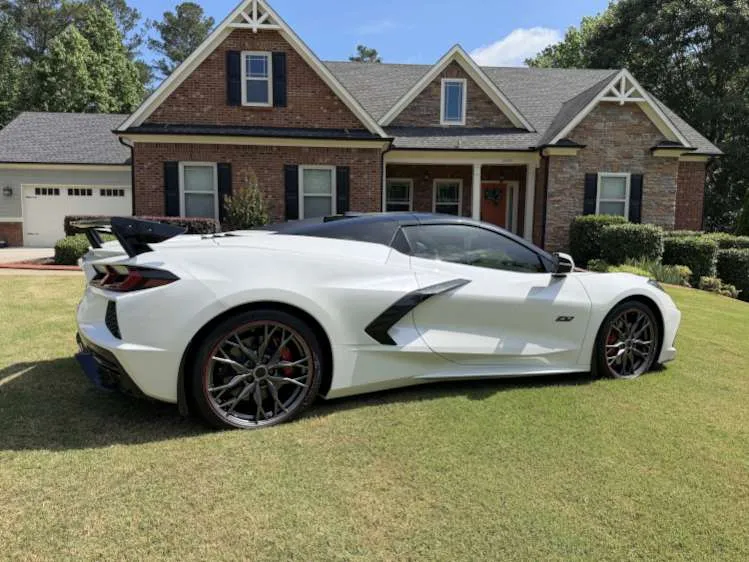
Besides his classic ’74, he currently drives a 2023 C8 in “Caffeine,” a color he says is pretty close to his ’74’s distinctive Root Beer shade.
When asked to choose a favorite, Robert immediately picked the C5. As he puts it, being a “big guy,” he really appreciates the extra room.
He calls them a true “touring Corvette” because they ride so nicely. After more than two decades with the ‘Root Beer’ Vette, he has no plans to sell it anytime soon, especially since his wife loves the car just as much as he does.

Restomod Perfection: Upgrading a 1974 Corvette’s Performance
Robert has put a ton of work into the engine’s external components, but here’s the cool part: for 24 years, he’s never had to touch the original block itself. Instead, he’s focused on upgrading everything around it, which really speaks to the durability of these classic cars.
One of the first things he did was remove all the original California smog equipment, since this car started its life in the Golden State. He then added a bunch of modern performance parts, like a new intake and an electronic distributor, to replace the old points system.
To keep it reliable, he also installed an aluminum cooling system with electric fans and an upgraded alternator. The result is a car that’s “good to go” and ready for a road trip.
And he didn’t stop there. He completely replaced the suspension with new coil springs, bushings, and ball joints.
One of the most common issues with older Corvettes is a leaky power steering system, so he tackled that head-on with a Borgeson conversion. This not only stopped the “oil dripping under the car” but also gave it a much more modern steering feel.
This Borgeson conversion is a prime example of the common issues owners of 1974 Corvettes face. While the Vette’s iconic design and potent big-block engine options made it a popular choice, a few common quirks and challenges come with ownership.

The Last of an Era: Why the 1974 Corvette is a Collector’s Dream
The 1974 Corvette is a unique and transitional model, making it a special part of the C3 generation. It was the final year for a few key features that many enthusiasts love, including the classic big-block engine and the true dual exhaust system.
That last part is a big deal, as later models switched to a single exhaust with a catalytic converter.
A few design changes also make the ’74 instantly recognizable. It was the only year to feature a two-piece urethane rear bumper with a vertical seam right down the middle.
This model was also the first to have body-colored urethane bumpers on both the front and rear, replacing the classic chrome bumpers. Though this wasn’t a popular move with some purists back in the day.
In fact, that same sentiment holds true today as the chrome-bumper Corvettes of the late ’60s and early ’70s are highly sought after.
But it was Larry Shinoda, a key C3 designer, who reportedly saw this bumper change as a positive. He felt the clean, uninterrupted lines were closer to his original “Shark” vision for the car.
In hindsight, the 1974 model’s urethane bumpers, while adding weight, helped the Corvette avoid the large, “park bench” bumpers seen on other cars of the era.
And, as we are to see in the sales numbers, the bumper change didn’t hurt sales one bit.

1974 Corvette Buyer’s Guide: Specs, Options, and Production
The 1974 Corvette sold a near-record 37,502 units, featuring the last big-block engine and the final model without catalytic converters. Production was split between 32,028 coupes and 5,474 convertibles.
The base coupe price was $6,001.50, and resonators were added to the dual exhaust to reduce noise.
The 1974 model year was a strong one for sales, with a near-record production of 37,502 units. The vast majority of these were coupes, with 32,028 produced, while only 5,474 convertibles were sold.
This year marked a significant transition, as it was the last Corvette to be produced without catalytic converters, and the final model to offer the big-block LS4 454 engine. To help quiet the car for a better ride, resonators were also added to the dual exhaust system.
Key features of the 1974 Corvette included the introduction of integrated lap and shoulder belts in coupes and the optional Gymkhana suspension package. The base engine was a 195 horsepower 350-4 V8, while an optional L82 version produced 250 horsepower.
For safety, the 1974 coupe introduced integrated lap and shoulder seat belts. In terms of performance, the base engine was a 350-4 V8 rated at 195 horsepower, but a more powerful L82 engine was available, providing 250 horsepower.
For drivers seeking improved handling, the optional FE7 Gymkhana suspension package included stiffer springs and a front stabilizer bar. The car also offered a custom interior package with leather trim and wood grain accents.
The 1974 Chevrolet Corvette was offered in a variety of exterior colors, including Classic White, Silver Mist, Corvette Gray, Corvette Medium Blue, Dark Green, Bright Yellow, Dark Brown, Medium Red, Mille Miglia Red, and Corvette Orange.

Power and Performance: Decoding the 1974 Corvette Engine Options
The 1974 Corvette offered three distinct engine options that provided a range of performance. These engines, along with the available transmissions, greatly influenced the car’s horsepower, torque, and acceleration.
The 1974 model year featured three different engine options to suit various driving styles.
- Standard Engine (Base 350-4 V8): This engine produced 195 horsepower at 4,400 RPM. Paired with the standard 4-speed manual transmission, it could achieve a 0-60 mph time of around 6.8 seconds.
- Optional L82 350-4 V8: The L82 engine offered a significant performance upgrade, producing 250 horsepower at 5,200 RPM. When equipped with this engine, the Corvette could accelerate from 0-60 mph in approximately 7.5 seconds.
- Optional LS4 454 Big-Block V8: The last big-block engine offered in a Corvette, the LS4 produced 270 horsepower. This engine provided a robust 380 lb-ft of torque for excellent low-end acceleration.
The available transmissions also played a key role in performance. While the standard transmission was a 4-speed manual, a close-ratio 4-speed manual was available with the L82 and LS4 engines.
The Turbo Hydra-matic automatic transmission was also a popular and durable option, installed in nearly two-thirds of all Corvettes built that year.

1974 Corvette Price Guide: What is a C3 Worth Today?
A 1974 Corvette can cost anywhere from around $5,000 for a project car to over $70,000 for a rare or exceptionally well-maintained example.
On average, a good-condition car typically sells for between $18,500 and $27,000, but the price depends heavily on a few key factors.
If you’re in the market for a 1974 Corvette, it’s important to know that the price can vary dramatically based on the car’s condition.
Factors influencing the price:
- Condition: Vehicles in excellent, original, or frame-off restored condition command the highest prices. In contrast, cars with cosmetic issues like a cracked bumper or extensive maintenance needs will be significantly cheaper.
- Mileage: Lower mileage generally indicates better overall condition and a higher value.
- Engine: Corvettes with the more powerful LS4 454 V8 or the L82 350ci engine are often more valuable than those with the base engine.
- Options & Modifications: Factory options like power windows or a custom interior trim can increase a car’s value. Additionally, professional or desirable modifications, such as an engine swap, can also have a positive impact on the price.
- History: A well-documented maintenance history, original paperwork, and a clean title add significant value and peace of mind.
Where to find a 1974 Corvette:
For those looking to find a 1974 Corvette, a number of online platforms specialize in classic cars.
Websites like Hemmings, Classic.com, and Classics on Autotrader list a wide range of examples, from low-priced project cars to high-end, restored models.
These platforms often provide price guidance based on condition and options, giving you a good starting point for your search.
A Pop Culture Icon: The 1974 Corvette’s Enduring Legacy
The Corvette as a whole has been a symbol of freedom, rebellion, and American ingenuity since its inception, and the 1974 model, in particular, cemented its status as a cultural icon.
The Corvette’s place in popular culture is perhaps best seen in its celebrity connections. F1 World Champion Kimi Raikkonen once purchased a 1974 Corvette that was previously owned by actress Sharon Stone, highlighting the car’s allure beyond the automotive world.
The National Corvette Museum even has a “Pop Culture and Corvette” exhibit that explores how the car has “raced its way into the hearts of celebrities” and appeared in “moments that defined generations”.
This model year also served as a canvas for unique, artistic expressions.
One example is a 1974 Corvette with hand-airbrushed murals of scenes from Star Wars. This car, which took over 1,000 hours to paint, earned awards at shows and demonstrated the Corvette’s role as a platform for personal expression.
The 1974 Corvette’s presence in media and its unique design have solidified its reputation, making it more than just a car. It’s an icon that represents an entire era and continues to be a favorite among enthusiasts, collectors, and celebrities alike.

Zora Arkus-Duntov’s Connection
Zora Arkus-Duntov, the legendary “Godfather of the Corvette,” owned a 1974 Corvette as his only personal Corvette, purchasing it upon his retirement in 1975.
While he was a relentless advocate for performance, his personal car, which is now at the National Corvette Museum, was more of a cruiser than a track car, with a big-block engine but an automatic transmission and power steering.
The fact that even the “Godfather” chose a 1974 model as his own speaks volumes about its enduring appeal.

Frequently Asked Questions (FAQ)
Question 1: What is a 1974 Corvette worth today? A 1974 Corvette can range in price from around $5,000 for a project car to over $70,000 for a rare or exceptionally well-maintained example. The average price for a car in good condition is typically between $18,500 and $27,000.
Question 2: What makes the 1974 Corvette unique? The 1974 model year is unique for several reasons. It was the last year to offer a big-block V8 engine, and the final model without catalytic converters. It is also the only year to feature a two-piece rear urethane bumper, a design that was a direct result of federal regulations.
Question 3: Is the 1974 Corvette a good car to restore? Yes, the 1974 Corvette can be a great car to restore, especially for enthusiasts. While some parts may be harder to find due to their one-year-only nature, the car’s maintenance is relatively straightforward for those familiar with classic American V8s. It is important to check the condition of the frame and “birdcage” for rust before starting a restoration.
Question 4: What are the most common issues with a 1974 Corvette? Common issues often found in C3 Corvettes include leaky brake calipers, a tendency for the cars to rattle, and problems with the vacuum-operated accessories like the pop-up headlights and wiper door. Owners often experience issues with interiors, electrical components, and power steering leaks.
Question 5: What was the fastest 1974 Corvette? The fastest 1974 Corvette was the one equipped with the optional LS4 454 big-block engine, which produced 270 horsepower and a robust 380 lb-ft of torque. The L82 engine was also a strong performer, with a 0-60 mph time of approximately 7.5 seconds.

More Than Just a Car
In the end, Robert’s “Root Beer” Corvette is more than just a car; it’s a testament to dedication and a rolling piece of art that tells a unique story.
From its humble beginnings tucked away in a basement to its current status as a show-winning icon, this ’74 Vette embodies the true spirit of a restomod done right.
Robert’s meticulous attention to detail and his passion for the Corvette community have turned a classic into a living legend.
Proving once more that sometimes, the best cars aren’t the ones fresh off the showroom floor, but the ones with a little bit of history, a lot of love, and a color as distinctive as “Root Beer.”
It’s a perfect example of how the right owner can take a unique, transitional model like the 1974 Corvette and turn it into a timeless masterpiece that will continue to turn heads for years to come.
Secure Your Weekly Briefing
Join a global community of Corvette stewards. Access archival deep-dives and high-octane field records—delivered with total editorial independence.
START YOUR BRIEFING