

Honda Powered C6 Corvette
Unruly Motorsports.
When it comes to the world of car enthusiasts, some rules are written in stone. A V8 belongs in a Corvette, and a Honda engine belongs in… well, a Honda.
But what happens when you throw out the rulebook and create something truly unexpected? You get a jaw-dropping, world-record-setting machine that redefines what’s possible.
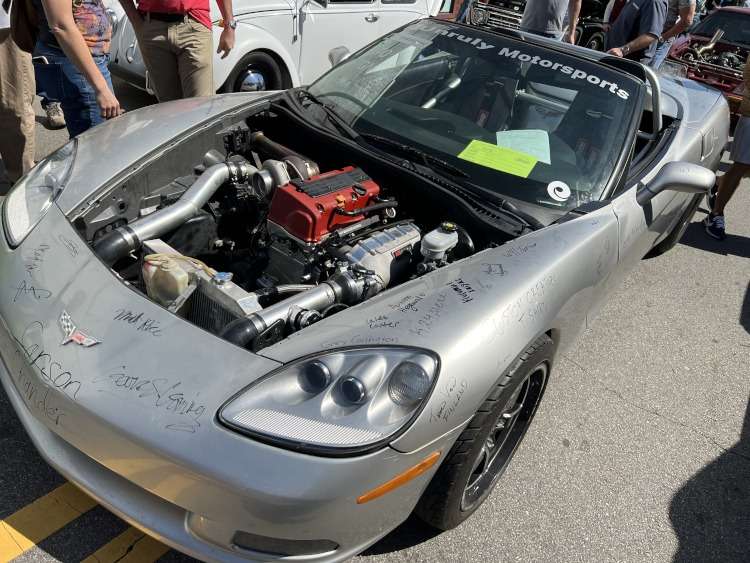
This is the story of a C6 Corvette, the venerable American sports car, with a heart transplant from an unlikely donor: a turbocharged Honda K24 engine.
Built by Kevin Prescott and Austin Brown of Unruly Motorsports, this audacious project is more than a car—it’s a statement.

Why Swap a Corvette’s V8 for a Honda Four-Cylinder?
The primary reasons for swapping a Corvette’s LS V8 with a Honda K-series engine are significant weight reduction and increased engine durability under high boost.
The K24 engine is substantially lighter than the original V8, which dramatically improves the car’s power-to-weight ratio for drag racing. The swap also presented a unique, unconventional engineering challenge for the builders.
With over two decades in the car scene, I thought I’d seen it all. LS swaps have become so common they’re practically an art form—we’ve seen them in everything from classic trucks to Japanese imports.
It’s an easy, well-documented path to big power. So when I first heard about a C6 Corvette with a Honda engine, my first thought was, “Why on earth would you do that?” Then I met Austin and Kevin.
Their answer was simple, yet profound: it’s about pushing boundaries and proving what’s possible. The idea of trading a big, heavy V8 for a lightweight, high-revving four-cylinder isn’t about being practical; it’s about being unruly.
What Are the Engine and Turbocharger Specs?
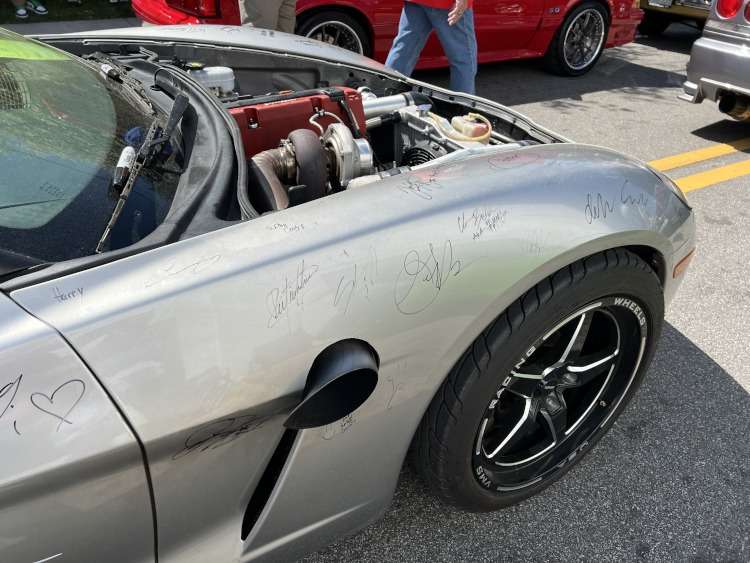
The Honda K24 engine in this build is heavily modified for racing, turning it into an absolute monster. You can’t just drop a stock Honda engine into a Corvette and expect it to survive.
This K24 is built from the ground up to handle the kind of boost most engines can only dream of. When Austin and Kevin walked me through the build sheet, it was like listening to a mad scientist describe his latest creation.
This isn’t just an engine; it’s a meticulously engineered piece of art. The block is bulletproof, and the internals are forged to withstand immense forces.
The noise it makes is unlike anything you’ve ever heard from a Corvette—it’s a high-pitched, turbocharged scream that’s equal parts shocking and exhilarating. It’s the kind of sound that makes you want to get a closer look.
The Heart of the Build: The Engine Block
The foundation is a K24A4 block from a Honda Accord, which was reinforced with a Jeffrey Morgan cylinder support system and O-rings to handle extreme power.
The rotating assembly includes Manley Pro Series “I” Beam Steel Connecting Rods and Wiseco 11:1 compression pistons.
The Head That Makes the Power
The cylinder head is equally impressive, outfitted with oversized 1-millimeter intake and 0.5-millimeter exhaust valves. It also features 98-pound springs, titanium retainers, and custom LSM cams to maximize airflow and performance.
Forced induction is supplied by a Pulsar DT 3584 RS turbo with a 60mm external wastegate.

How Does a Honda Engine Connect to the Rear Wheels?
The Corvette’s stock rear-mounted transaxle was replaced with a drag-specific setup. Power is transferred via a Powerglide transmission, a Dacco torque converter, and a custom driveshaft.
The car’s rear end is a robust Ford Explorer 8.8-inch offset rear equipped with Chromoly axles and C-clip eliminators.
One of the most significant challenges of this swap was ditching the factory Corvette drivetrain. The C6’s transaxle setup is great for weight distribution on a road course, but for a high-horsepower drag car, it’s a complicated liability
Austin and Kevin simplified things dramatically. They went with a Powerglide transmission, a legendary two-speed drag racing gearbox known for its durability and efficiency.
They then sourced a common and robust Ford 8.8 rear end and reinforced it for serious power.
It’s a complete departure from the Corvette’s original design, but every part was chosen to put every ounce of horsepower to the pavement as efficiently as possible.
What Was the Dyno and Quarter-Mile Performance?
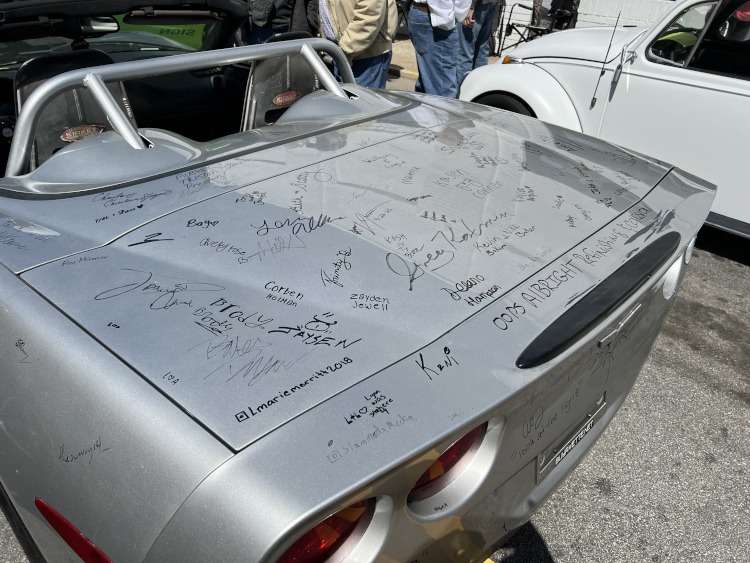
The Honda-powered Corvette set a world record for a four-cylinder Corvette by completing the quarter-mile in 11.081 seconds at 135.67 miles per hour. On a dyno, the engine produced 917 horsepower and 563 lb-ft of torque at 30 pounds of boost.
Putting this car on the dyno was a real treat. On its first big pull, the guys were able to crank it up to 917 horsepower. That’s a massive number, especially from a Honda four-cylinder. The best part?
They did it on “only” 30 pounds of boost. With their sights set on the elusive four-digit horsepower mark, they knew they had more left in the tank even without a bigger turbo.
Their hard work paid off when they took it to the drag strip and made history, setting a world record with that 11.081-second pass. That’s not just fast; that’s a new benchmark for what’s possible.
What Are the Future Plans for the Build?
Unruly Motorsports plans to increase the car’s power to over 1,000 horsepower before upgrading to a larger turbo. Planned modifications include a ten-point roll cage and a switch to high-performance fuels like Q16 or Renegade Pro E112.
The final goal is to achieve an eight-second quarter-mile time.
A car like this is never truly “finished.” It’s an evolving project, a constant pursuit of perfection and performance. Austin and Kevin have their eyes on the next big number: 1,000 horsepower. But they’re not stopping there.
They’re meticulously prepping the car for its next phase, which includes a full roll cage for safety and more weight reduction to get the car down to a lean 2,250 pounds.
These guys are so confident in their setup that they believe the car will eventually break into the eight-second range. Given what they’ve already accomplished, I wouldn’t bet against them.
It’s that kind of unyielding dedication that makes this car so special, so unruly.
*Last updated on 8/23/2025
Secure Your Weekly Briefing
Join a global community of Corvette stewards. Access archival deep-dives and high-octane field records—delivered with total editorial independence.
START YOUR BRIEFING