

The 2025 IMSA WeatherTech SportsCar Championship season is officially wrapped, and for anyone wearing Corvette Racing yellow, it was a clean sweep.
The Motul Petit Le Mans at Michelin Raceway Road Atlanta didn’t just cap off the season; it delivered a grueling, chaotic, and ultimately triumphant 10-hour endurance test that cemented the Corvette Z06 GT3.R’s pedigree.
Corvette Racing, now officially Corvette Racing by Pratt Miller Motorsports, didn’t just win a race—they clinched the trifecta: the Drivers’, Teams’, and Manufacturers’ Championships in the competitive GTD Pro class.
As a long-time Corvette racing observer, I’m still running high on octane. This wasn’t just a victory of speed; it was a victory of strategy, reliability, and sheer engineering dominance.
We’re going to break down the technical specifics of the win, dissects the C8.R’s performance advantage on the treacherous 2.54-mile circuit, and celebrates the incredible driving crew who got the job done.
We were thrilled to be trackside for this season finale!
And for those looking for more racing action, we recommend our series: From the Paddock: The Roar of Corvette & Vintage Racing.

No. 3 Corvette Z06 GT3.R
The 2025 Championship Trifecta: A Historic Sweep
The 2025 Motul Petit Le Mans (October 11, 2025) secured a complete championship sweep for Chevrolet and Corvette Racing in the IMSA GTD Pro class. This marked a significant achievement in the second year of the Corvette Z06 GT3.R program.
- Drivers’ Champions: Antonio Garcia and Alexander Sims (No. 3 Corvette Z06 GT3.R)
- Teams’ Champions: Corvette Racing by Pratt Miller Motorsports (No. 3 Z06 GT3.R)
- Manufacturers’ Champions: Chevrolet (Securing the brand’s 15th IMSA GT Class Title)
The No. 3 team entered the final race with a narrow 18-point lead over the No. 81 DragonSpeed Ferrari and clinched the title with a methodical P3 class finish. The No. 4 Corvette secured P2 to seal the Manufacturers’ title for Chevrolet.
Truth be told, we’ve been waiting for this moment since the Z06 GT3.R debuted, and it was worth the wait. This isn’t a small victory; this is historic validation for the entire C8.R program under the GTD Pro ruleset.
Think about the pressure Antonio Garcia and Alexander Sims were under. They had an 18-point cushion over the DragonSpeed Ferrari, but at a 10-hour race where anything can happen—especially under caution lights—that lead felt paper-thin.
The strategic brilliance came from Pratt Miller Motorsports, who guided the No. 3 car (shared with endurance ace Daniel Juncadella) to a clean, methodical third-place finish.
Their focus was pure reliability and minimizing mistakes.
Meanwhile, the sister No. 4 Corvette of Tommy Milner, Nicky Catsburg, and Nico Varrone played a perfect supporting role, finishing second in class. Their result guaranteed Chevrolet the crucial Manufacturers’ crown.
That Manufacturers’ Championship is Corvette’s 15th IMSA GT class title—a number that speaks volumes about consistency and engineering over decades.
When Eric Warren, GM’s VP of Global Motorsports Competition, congratulated the team, it was confirmation: this was a total team effort, and every single person executed flawlessly, making this the most successful factory GT sweep since the GTLM era.

Instrumental In Securing The Manufacturers’ Championship.
Road Atlanta: The Circuit that Demands Respect
Michelin Raceway Road Atlanta is a 2.54-mile, 12-turn natural terrain road course known for its extreme elevation changes (approximately 125 feet drop from Turns 3 to 5) and high-speed complexity. The key technical demands for GTD Pro cars include:
- The Esses (Turns 3 through 5): A high-commitment, downhill section demanding maximum aerodynamic stability and chassis stiffness.
- Turn 10A/10B (The Chicanes): The lowest speed section, requiring massive braking stability, driver precision, and instantaneous traction control on exit.
- Turn 12 (The Final Turn): A critical, terrifyingly fast downhill approach to the finish line, testing the car’s ultimate aero balance and the driver’s nerve as prototypes dart past.
Road Atlanta is deceptively simple on paper—just 12 turns—but when you’re driving a 500-horsepower GT3 car with 30 prototypes flying around you, it becomes a wild 10-hour ballet of speed and terror.
It’s a classic, old-school track built back in 1970 that rewards bravery and punishes hesitation.
Taking with the drivers, the real challenge is finding places to breathe. The famous Esses are terrifying: you drop downhill, relying completely on the downforce of the C8.R’s massive diffuser to keep the car glued.
If you get it wrong there—or if a slower car forces you offline—you lose the rear end and become a YouTube crash highlight.
The commitment needed through those left-right-left sweepers, where you’re loading the tires and the chassis simultaneously, is unparalleled in North America in our opinion.
For the C8.R, its mid-engine layout is a huge advantage through the Esses and the downhill run to Turn 12. Unlike front-engined rivals, the engine weight is already centered, giving the car supreme stability under high lateral load.
This chassis was built for high-speed balance, and Road Atlanta is its ultimate proving ground. Petit Le Mans is basically 10 hours of running qualifying laps while dodging traffic in the dark, and that demands a chassis that doesn’t fade.

The C8.R’s Technical Edge: LT6 Power in GT3 Spec
The Corvette Z06 GT3.R derives its core architecture and power from the road-going C8 Corvette Z06. Key technical elements include:
- Engine: A racing-optimized version of the 5.5L DOHC LT6 V8 (Naturally Aspirated), which shares about 70% of the production components with the street car. Output is regulated by IMSA’s Balance of Performance (BOP) to roughly 500–550 hp, well below the 670 hp of the road car.
- Chassis: Based on the factory aluminum chassis, providing exceptional torsional rigidity and making the car predictable across endurance stints.
- Tires: The mid-engine layout allows for superior tire management, distributing load optimally and reducing degradation—a necessity for the abrasive Road Atlanta surface.
- Brakes: Features a 6-piston front / 4-piston rear AP Racing braking system with quick-change hardware to minimize pit stop time during the 10-hour duration.
| Specification | Corvette Z06 GT3.R (GTD Pro) | Road-Going C8 Z06 |
|---|---|---|
| Engine Configuration | 5.5L DOHC V8 (Naturally Aspirated, Dry Sump) | 5.5L DOHC V8 (Naturally Aspirated, Dry Sump) |
| Output (BOP Adjusted) | ≈500–550 hp | 670 hp (Stock Road Car) |
| Chassis Basis | Factory Aluminum Chassis | Factory Aluminum Chassis |
| Key Racing Advantage | Mid-Engine Balance, DOHC Powerband, Reduced Tire Wear |
The biggest win for Corvette this season was proving the durability of that 5.5L DOHC LT6 V8 in the GT3.R. Everyone knew the road car’s engine was a masterpiece, but racing is different.
Racing is about sustained, brutal punishment. The fact that the race engine shares so much DNA with the street car is a testament to the Z06 team.
Under IMSA’s Balance of Performance (BOP) rules, the C8.R’s power is capped below the stock Z06’s 670 horsepower, but that DOHC engine brings an entirely different advantage: a wider, more linear powerband.
You don’t get the huge torque spike of some competitors; instead, you get relentless, usable power delivery out of slow corners like Turn 10A.
This flexibility minimizes the risk of wheel spin when the tires are cold or worn, making the job of the endurance drivers much easier.
But let’s pull back the curtain and let you in on a little secret: the true hero is the aluminum chassis.
Because the GT3.R uses the factory Z06 architecture, it shares that incredible structural rigidity. This is vital at Road Atlanta, where the car hits huge compression changes and severe curb strikes.
A rigid chassis means the suspension geometry stays predictable, allowing the team to dial in the perfect setup without chasing instability.
This allowed the Corvette, across all 10 hours, to manage Michelin tire degradation better than the Ferrari, which was crucial for the final stint in the Georgia night.

Dissecting the Strategy: Reliability Wins Championships
Corvette Racing’s championship strategy centered on reliability and consistency, exploiting the Z06 GT3.R’s minimal tire degradation advantage. Key strategic pillars included:
- Tire Management: The mid-engine C8.R chassis reduced the load on the rear tires compared to front-engine rivals, allowing for longer, more consistent stints.
- Fuel Strategy: Daniel Juncadella excelled in his stints by pushing the car through traffic while maintaining fuel targets, ensuring they had maximum flexibility for the final hour.
- Pit Stop Execution: The Pratt Miller crew maintained flawless, low-variance pit stops, minimizing the risk of errors under pressure, especially during high-stakes caution periods.
- Minimum Finish: Knowing they only needed to finish ahead of the No. 81 Ferrari, the No. 3 team focused on survival and avoiding unnecessary risks.
In endurance racing, speed is nothing without reliability. The 2025 Petit Le Mans was a war of attrition, and the Corvette’s championship strategy was pure chess, not checkers.
They weren’t focused on setting a track record; they were focused on the Team championship at a minimum.
The biggest strategic edge the C8.R offered was tire management.
At Road Atlanta, with its high-speed loading and aggressive surface, teams usually burn through their tire allocation, but the mid-engine balance of the Corvette handles the Michelins with surprising finesse.
We saw evidence of this in the late afternoon where Antonio Garcia pulled off a double-stint, saving a full set of tires for the final battle under the headlights. That decision was gold.
In the final three hours, pit wall made the call to switch to “championship mode.” This meant Juncadella and Sims focused on maintaining a clean gap to the Ferrari, relying on the sister car, the No. 4, to put pressure on the leader.
This perfect teamwork and consistent execution in the pits—where the Pratt Miller crew repeatedly delivered stops averaging under 40 seconds—meant the team controlled their own destiny.
They knew that if they simply kept the car clean, the championship was theirs, and they executed that strategy perfectly.

The Driving Force: Garcia and Sims’ Championship Mettle
The No. 3 Corvette Z06 GT3.R Drivers’ Championship was secured by Antonio Garcia and Alexander Sims, who entered the final race with an 18-point lead and clinched the title with a P3 class finish.
- Antonio Garcia (Six-Time IMSA Champion): Known for his aggressive race craft and unparalleled ability to manage tire wear in the closing stages. His P3 finish secured his sixth IMSA title, all with Corvette Racing.
- Alexander Sims (Two-Time IMSA Champion): Provided crucial speed and consistency in the mid-race stints, leveraging his recent 2023 GTP Drivers’ title experience to guide the GTD Pro program.
- Endurance Driver: Daniel Juncadella completed the lineup, serving as the necessary third driver for the 10-hour race and providing championship-caliber relief stints.
You can’t talk about Corvette Racing without talking about Antonio Garcia. The man is pure racing mettle.
He’s now a six-time IMSA champion, and his experience showed this year. His ability to deliver fast laps while pushing the tires right up to the limit—but never over it—is legendary.
When it came time for the championship battle, Garcia demonstrated championship mettle, driving a clean, error-free final stint to bring the car home and shut the door on the Ferrari challenge.
But the success wasn’t just on Garcia. Alexander Sims, coming over to the GTD Pro class after winning the GTP championship in 2023, brought a fresh perspective and massive speed, especially in the tricky transition from day to night.
He and Garcia won the Michelin GT Challenge at VIR earlier in the season—a result that was powered by a brilliant undercut strategy—which proved their raw pace and commitment. Sims is now a two-time champion, and he earned this one with relentless consistency.
Then you have the No. 4 Corvette of Tommy Milner, Nicky Catsburg, and Nico Varrone. They were out of the Drivers’ title fight, but they drove like champions, taking P2 at Petit Le Mans.
Their job was to race the rivals of the No. 3 car, providing pressure and protection.
They executed that team order perfectly, ensuring Chevrolet earned every possible Manufacturer point, proving that Corvette Racing operates as one cohesive, championship-driven unit focused on the overall team victory.

The Bob Akin Award In The GTD class.

The Historical Echo: Ninth Win at Petit Le Mans
The 2025 victory marks the Corvette Racing program’s ninth class win at the Motul Petit Le Mans since their debut in 1999. This history includes major wins across the GTS, GT1, and GT classes of the former American Le Mans Series (ALMS).
- Early Dominance (C5-R): Secured five class victories in the race’s first seven years (1999, 2000, 2001, 2002, 2004).
- C6.R Era Highlights: Included the famous 2010 win achieved via a last-lap pass for the lead, demonstrating strategic brilliance.
- Legacy: The 2025 GTD Pro win extends Corvette Racing’s record of endurance success at the 10-hour race and is the culmination of decades of engineering commitment.
The 2025 victory is deeply satisfying because Road Atlanta holds so much Corvette history. When Ron Fellows, Johnny O’Connell, and the C5-R crew showed up in the early 2000s, they weren’t just racing; they were establishing a dynasty.
We can count eight class victories before this C8.R win, and every one was brutal.
I remember the 2010 Petit Le Mans race where the C6.R had a massive final-lap pass to win. Corvette Racing’s Oliver Gavin passed the Risi Competizione Ferrari on the final lap.
The victory was Corvette Racing’s first win in the new C6.R GT2 program, culminating a season of struggle for the team.
That moment defined the commitment of Corvette Racing: never give up, even if you are out of fuel and running on fumes. That spirit is baked into the DNA of the C8.R team today.
The C5-R started the trend, winning 5 out of 7 races in the early 2000s, and the C6.R continued the legacy with its own triumphs.
What’s crucial about this GTD Pro championship is that it validates the whole customer racing model. When Corvette Racing retired its factory GTLM program, there were worries.
But stepping up as a partner to Pratt Miller Motorsports and successfully debuting the Z06 GT3.R in the customer-spec GTD Pro class, only to sweep the championships in year two, is a statement.
It proves that the foundation of the Corvette platform is solid enough for factory speed, even in a customer-focused series. This 2025 title is a capstone, proving that the Corvette isn’t just surviving the GT3 transition—it’s dominating it.


The Customer Support Program: Expanding the Yellow Army
The 2025 Petit Le Mans showcased the strength of Chevrolet’s customer support program beyond the factory effort. Two customer-run Corvette Z06 GT3.Rs competed in the Pro-Am GTD class:
- AWA (No. 13 GTD): Driven by Matt Bell, Orey Fidani, and Lars Kern. Orey Fidani was tied for the lead in the (highest-scoring Bronze GTD driver) heading into the finale. At the end of race, it was Lars Kern in the number 13 Corvette Z06 GT3.R who won the Bob Akin Award. Now that, is a great way to end the season!
- DXDT Racing (No. 36 GTD): Entered by Charlie Eastwood, Alec Udell, and Salih Yoluc.
The fact that customer cars were competing for championships (Akin Award) and testing new setups reinforces the C8.R’s inherent usability and reliability across varied Pro-Am driver lineups, demonstrating strong brand presence throughout the IMSA paddock.
We often focus on the factory GTD Pro team, but the wider success of the Corvette program depends entirely on the customer teams like AWA and DXDT Racing.
Seeing Orey Fidani, the Bronze driver for the No. 13 AWA Corvette, fighting for the Bob Akin Award—which gives the winner an automatic entry to Le Mans—shows how well the Z06 GT3.R package works in the Pro-Am (GTD) environment.
The GTD class is tougher in some ways because you have Bronze-rated gentlemen drivers running the car for significant stints.
The fact that the AWA Corvette has been challenging for the championship all year, starting with a win at Daytona, proves that the C8.R is robust, forgiving, and predictable enough for non-factory pros to handle at maximum attack.
The DXDT team, new to the platform, also got valuable experience in the tough 10-hour format.
This commitment to the customer package is the future of Corvette Racing. It means that whether you’re a factory superstar like Garcia or a passionate privateer like Fidani, the C8.R platform is reliable enough to deliver podium finishes.
This widespread success across the field ensures the Corvette brand stays healthy and competitive in endurance racing for years to come.

Race Day Energy & Excitement
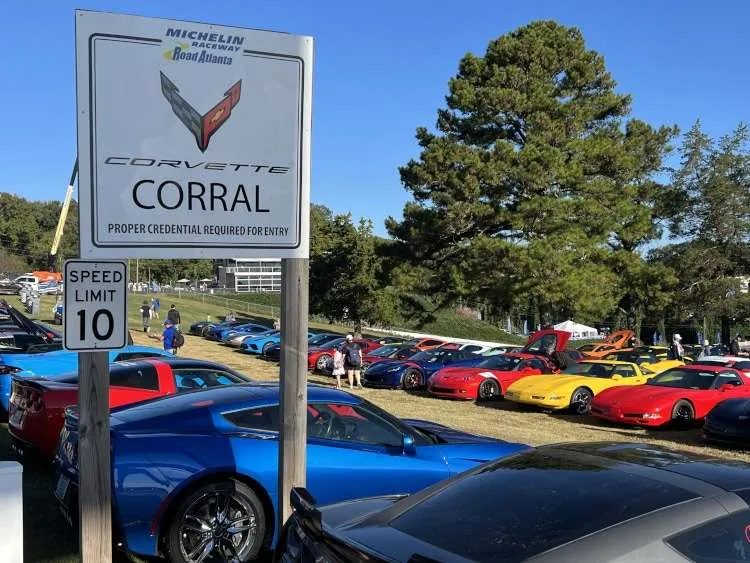
For those of us in attendance, the atmosphere at Michelin Raceway Road Atlanta for the Petit Le Mans finale was electric. In so many ways, it matched the intensity of the on-track battle.
Official attendance figures for the 2025 event are not yet publicly available, but the race is known to consistently draw over 150,000 fans throughout the four-day weekend, often setting record attendance numbers for the IMSA calendar.
Further cementing the importance of this event to Georgia, Governor Brian P. Kemp served as the official Grand Marshal for the 2025 Motul Petit Le Mans, officially welcoming participants and fans to the state.
For the Corvette community, the day was especially meaningful; the Saturday morning experience in the Chevrolet Pavilion, which opened at 8:00 am for breakfast, included presentations from industry giants like Mobil 1, Michelin, and Corvette engineers, including Josh Holder and Tony Roma.
Classic Glass Corvette Club of Marietta handled the parking and check-in duties providing seamless service as true fans. This dedicated club has handled the Corvette Corral parking and pavilion checkin for many years.
The race day also featured a highly anticipated Corvette ZR1X Walk-around at the Fan Walk area, drawing massive crowds for a look at the cutaway model and the presentation hosted by Holder and Roma.

Defining a Dynasty
The 2025 Motul Petit Le Mans was not just the end of an IMSA season; it was the definitive statement for the Corvette Z06 GT3.R. We witnessed the convergence of decades of Corvette Racing history, the technical superiority of the mid-engine DOHC LT6, and the unwavering strategic support of Pratt Miller Motorsports.
Antonio Garcia now has six championships, Chevrolet has 15 Manufacturers’ titles, and the C8.R platform has proved its resilience in the most competitive sports car class in the world.
The sweep was more than just numbers—it was a triumph of American endurance engineering on one of the continent’s most demanding circuits. The Corvette dynasty continues, and the yellow flags are flying higher than ever.
The next challenge is already on the horizon: defending the crown in 2026.
Fuel Your Passion: Get Our Best Articles Delivered To Your Inbox – Free
Sign up now to receive every new review, tech guide, and event recap directly to your inbox. It’s fast, free, and easy!
SUBSCRIBE NOW