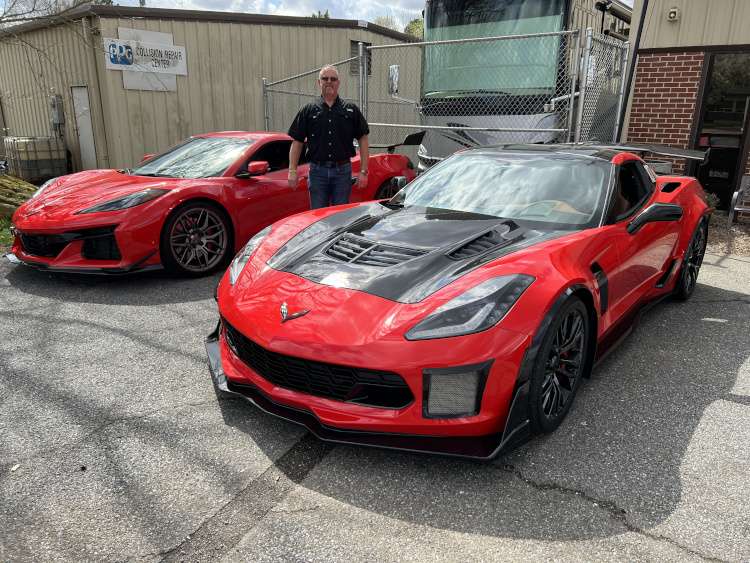


For decades, the name Corvette has been synonymous with American sports car performance. But the legend of the Corvette goes far beyond the street.
The story of Corvette Racing is one of grit, innovation, and a relentless pursuit of victory that has not only created a championship-winning team but has also profoundly influenced the very cars we drive today.
The official factory-backed racing program for Chevrolet got its start in 1999 with the introduction of the C5-R, a race car built on the foundation of the fifth-generation Corvette.
While GM had a history of unofficial racing support, this was the first time they were all in. Doug Fehan, the program manager for Corvette Racing, and Herb Fishel, then executive director of GM Racing, were the architects of this groundbreaking effort.
Fehan recalls the moment of approval: “It was the first racing program he had ever seen that made any sense at all. You could have heard a pin drop in the room.”
The key to their success was a “synergistic relationship” between the racing team and the production car engineers, ensuring that the lessons learned on the track could be applied to future street models.
Dave Hill, the Corvette chief engineer for the C5 and C6 generations, fully embraced this philosophy, changing his personal stationary to read, “Bring the racing spirit to work.” This vision set the stage for a legacy that continues to this day.
And for those looking for more racing action, we recommend our series: From the Paddock: The Roar of Corvette & Vintage Racing.


The C5-R: The Founder of the Corvette Racing Legacy
The Corvette C5-R was the car that started it all. Based on the C5 production car, it was a beast designed purely for motorsports.
This car was a huge step forward from its predecessors, benefiting from the C5’s hydroformed steel frame rails, which formed the perfect basis for a tube frame racing car.
The C5-R was an incredible success right out of the gate. From 1999 to 2004, Corvette Racing entered 54 races and won 35 of them.
Their impressive resume includes 31 American Le Mans Series (ALMS) victories, three wins at the Mobil 1 Twelve Hours of Sebring, and three wins at the Motul Petit Le Mans.
The team also took home three consecutive ALMS GTS class championships.
The driver roster during this golden era was a who’s who of racing talent, including Ron Fellows, Johnny O’Connell, Chris Kneifel, Andy Pilgrim, and the legendary Dale Earnhardt and Dale Earnhardt Jr., who drove a C5-R to a memorable fourth-place finish at the 2001 Rolex 24 at Daytona.
That race, in particular we remember well, as we cheered on the team over the course of a bone-chilling wet Rolex 24 racing weekend.
The C5-R’s success wasn’t limited to the US. It secured three class wins at the prestigious 24 Hours of Le Mans in 2001, 2002, and 2004. This incredible performance proved that Corvette could compete and win on the world stage.
The C5-R was constantly evolving. Initially powered by a 6.0-liter V8 engine, it was soon upgraded to a larger 7.0-liter unit, which became its standard powerhouse for the rest of its career.
The car’s aerodynamics were also continually refined, with changes to the hood, and the addition of a large diffuser and wing. These changes helped the C5-R to stay competitive against rivals from Dodge and Porsche.
An interesting innovation was the inclusion of a rear-view camera and monitor, a solution to the lack of a rear window caused by the car’s structural framework and fuel tanks. This was a technology that was ahead of its time.

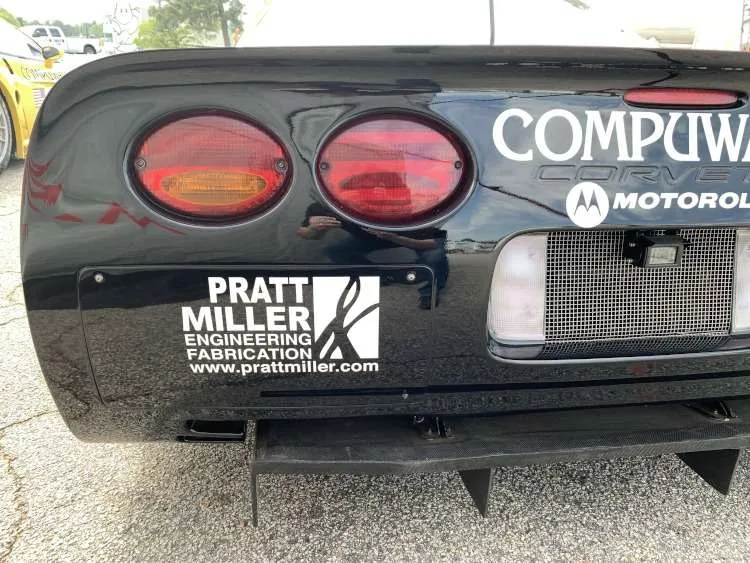
The C6.R: A Leap Forward in Technology
Following the C5-R’s final season in 2004, which it went undefeated, the C6.R had big shoes to fill. The development of the C6.R was unique because, unlike its predecessor, it was developed at the same time as the C6 production car.
This collaboration between Pratt & Miller and GM engineers allowed for a more integrated design, with racing elements being adapted to the road car and vice versa.
One of the most significant changes from the C5-R to the C6.R was the bodywork. Pratt & Miller’s input led to the C6 production car having fixed, exposed headlights and a front-mounted radiator grille.
This eliminated the need for the “frog-eyed” headlight covers and front grilles that were necessary on the C5-R, which created drag and made cooling difficult. The C6.R also took on the design cues of the C6 Z06, with a wider, more aggressive stance and improved aerodynamics.
The new body, combined with an enhanced aero package, allowed the C6.R to reach higher speeds on long straights like the Mulsanne Straight at Le Mans, where the C5-R had struggled.
Under the hood, the C6.R was powered by a new 7.0-liter LS7.R V8 engine, which was more closely based on the LS7 from the Z06 production car. This engine was so successful it won the Global Motorsports Engine of the Year award in 2006.
The C6.R also introduced new technologies like an air conditioning system for driver comfort and a video camera in the rear bumper to help with rear visibility.
The C6.R continued the winning tradition, securing multiple American Le Mans Series championships and race wins at the 24 Hours of Le Mans.
The rivalry between Corvette Racing and the Aston Martin DBR9s in the GT1 class was epic, pushing both teams to new levels of performance.
In 2009, Corvette Racing transitioned to a new GT2 program with the C6.R, and even won the 2011 GTE-Pro class at Le Mans.


Corvette C7.R: A Champion on and Off the Track
The C7.R, which debuted in 2014, wasn’t just another race car; it was the ultimate proof of everything Corvette Racing had been building toward since the C5-R.
This was the generation where the line between the race car and street car got blurrier than ever before. Think about it: the C7.R was developed in parallel with its road-going twin, the C7 Z06, and they even shared an aluminum frame.
As Doug Fehan, the Corvette Racing program manager, noted, the C8 mid-engine Corvette “never would have happened without the racing program.” This synergy was a testament to the technology transfer model established years earlier.
The C7.R Corvette is renowned for its successful racing legacy, especially in grueling endurance events like Le Mans, Daytona, and Sebring. It clinched multiple championships for Chevrolet, including consecutive GTLM Manufacturer Championships (2016-17) and Driver and Team Championships (2016-18).
In its first year alone, the C7.R won four races in a row, with drivers Jan Magnussen and Antonio Garcia earning the Driver Championship thanks to their consistent performance.
This car truly brought a new level of success and innovation to Corvette Racing, including reintroducing direct fuel injection.


A Legacy of Victory: The C7.R’s Championship Era
The C7.R’s winning streak continued in dramatic fashion. In 2015, the team achieved endurance racing’s “triple crown,” winning the Rolex 24 at Daytona, the Mobil 1 Twelve Hours of Sebring, and the 24 Hours of Le Mans—a monumental feat.
That Le Mans win was Corvette Racing’s eighth at the historic circuit. The 2016 season brought a nail-biting photo finish at the Daytona 24 Hours, with the number 3 and 4 cars separated by a mere 0.034 seconds.
The number 4 car went on to have a dominant year, sweeping the drivers’, team, and manufacturers’ championships, and securing the team’s milestone 100th win at Lime Rock.
The success was so consistent that the team repeated the championship sweep in 2017.
In 2018, the number 3 Corvette secured a “three-peat” for the team championship through a series of consistent podium finishes, proving that reliability and teamwork are just as important as speed.
The C7.R’s final year in 2019 was a fitting farewell; while it didn’t win a race, it tied for second in the GTLM class, a final nod to its enduring legacy.


A Legacy That Lives On
As the sun set on the Petit Le Mans in 2023, it marked the end of an era for Corvette Racing’s official factory team. But the legacy isn’t over.
The team will transition into Corvette Racing by Pratt Miller, with factory backing from GM, to focus on customer teams with the new Corvette Z06 GT3.R. The foundation laid by the C5-R, C6.R, and C7.R is immortal.
This was underscored by the C5-R’s induction into the inaugural class of the IMSA Hall of Fame in 2023.
The Corvette Racing program has achieved 127 wins worldwide, nine victories at the 24 Hours of Le Mans, and 14 drivers and manufacturers titles.
This incredible record is a testament to the vision of people like Doug Fehan and Herb Fishel, the engineering genius of Pratt & Miller, and the fearless skill of drivers like Ron Fellows, Johnny O’Connell, and Jan Magnussen.
The racing spirit they brought to work every day has not only won championships but has also made the street Corvette a better, more capable car for all of us.
Fuel Your Passion: Get Our Best Articles Delivered To Your Inbox – Free
Sign up now to receive every new review, tech guide, and event recap directly to your inbox. It’s fast, free, and easy!
SUBSCRIBE NOW