

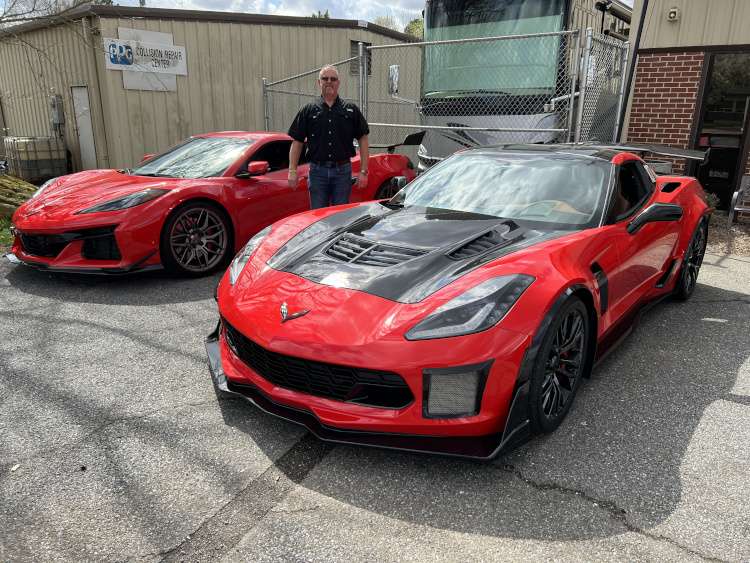
C8 Z06 & C7 Z06 Corvettes
Key Takeaways: The Evolution of the Z06 Track Experience
- Driver Persona: The C7 rewards the “hero” who can tame a monster; the C8 rewards the “professional” who can master a complex, integrated system.
- Philosophical Shift: The transition from C7 to C8 marks a move from a front-engine “Wrestler” (physical, torque-heavy) to a mid-engine “Surgeon” (mental, momentum-based).
- Power Delivery: The C7 Z06 relies on a supercharged LT4 with massive low-end torque (740 lb-ft), while the C8 Z06 utilizes a naturally aspirated, high-revving LT6 with an 8,600 RPM redline.
- Thermal Management: The C7 requires significant aftermarket cooling investments (approx. $15,000) for track reliability; the C8 is engineered to be track-ready from the factory.
- Transmission Impact: The C7’s 7-speed manual offers high mechanical engagement but increases driver workload, whereas the C8’s 8-speed DCT allows the driver to focus entirely on line and aero.
- Handling Dynamics: The C7 suffers from nose-heavy weight distribution and front-end tire stress; the C8 provides a balanced mid-engine pivot that rewards precision and trusts high-speed aerodynamics.
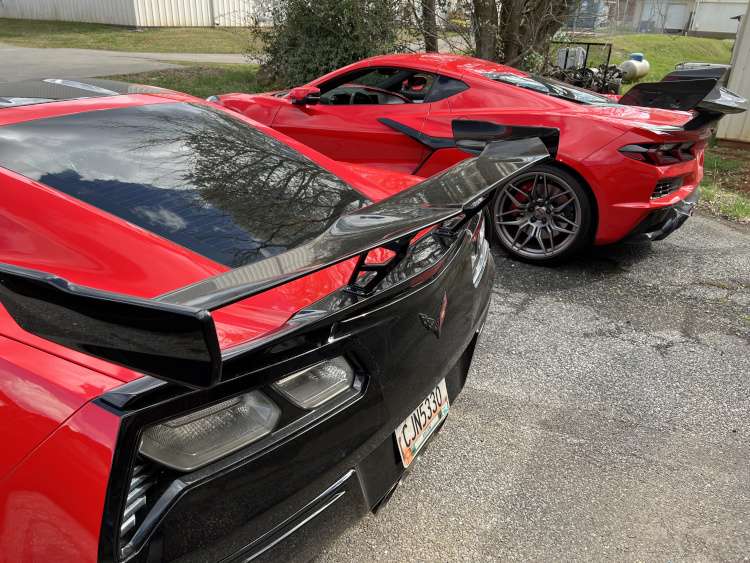
The Heavyweight Bout
The sun beats down on the hot pavement outside Scott & Aileen Marshall’s Automotive & Performance Center, and I’m standing between two eras of American muscle.
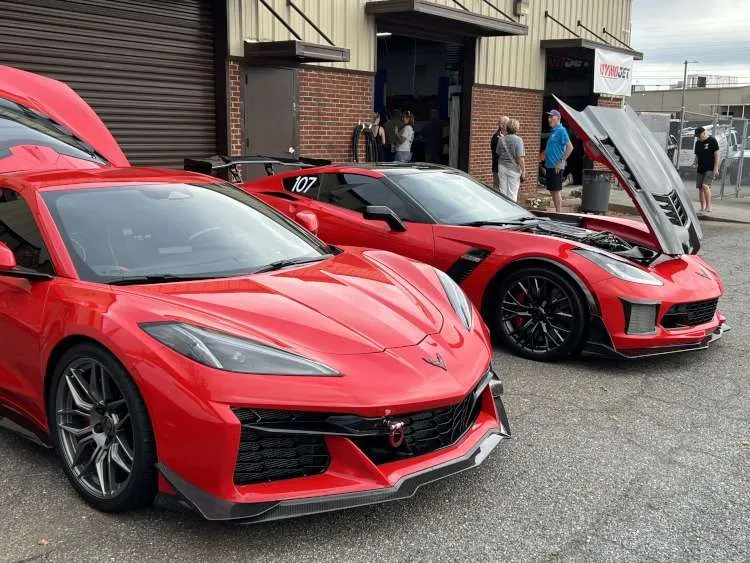
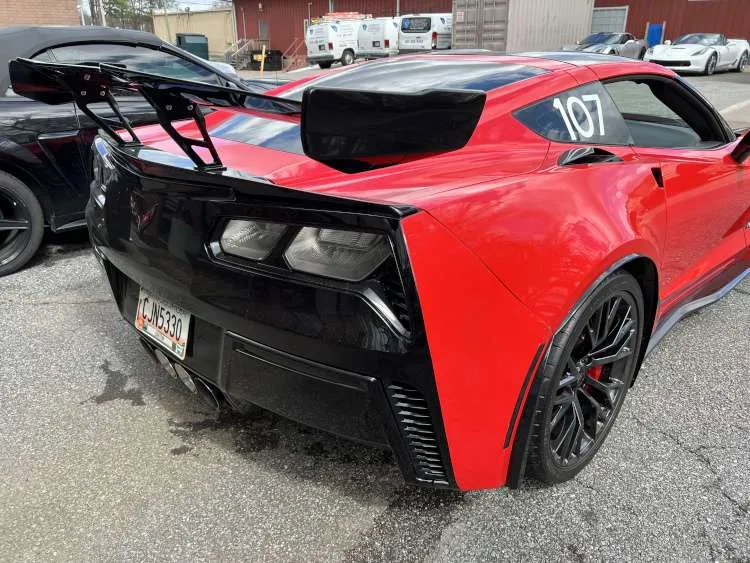
On my left sits a 2015 C7 Z06, a front-engine brute with a 7-speed manual that looks like it wants to pick a fight. On my right, the new C8 Z06 idles with the exotic, high-pitched hum of a mid-engine supercar.
To the casual observer, they both wear the Z06 badge and Corvette Red paint, but to Scott Marshall—the man who owns, maintains, and tracks both—they couldn’t be further apart.
Scott doesn’t just “drive” these cars; he experiments with them. He’s spent years refining the C7 into a reliable track weapon and months learning the steep curve of the C8’s mid-engine physics.
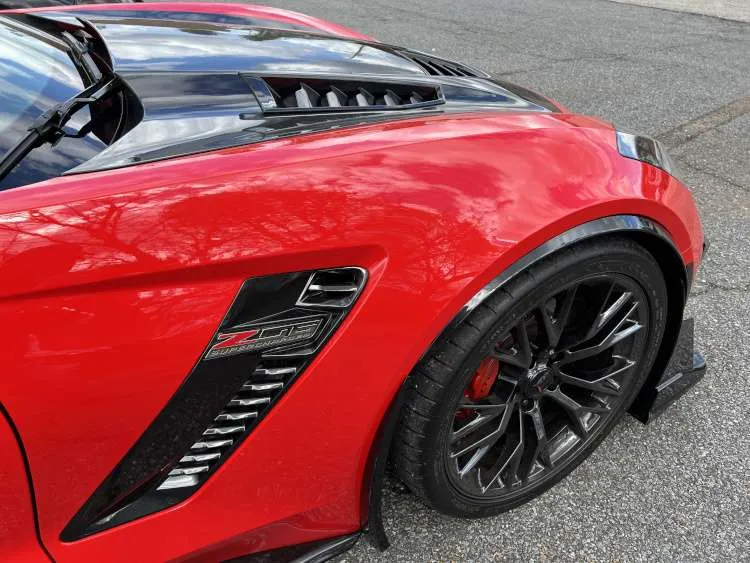
The C7 Z06: Wrestling the Monster
Driving the C7 Z06 on a road course is a physical workout. With a supercharged LT4 pushed to 715 horsepower and a staggering 740 lb-ft of torque, the car feels alive—and a bit angry. Scott describes the experience as a constant “wrestling match”.
- The Power Delivery: Unlike the high-revving C8, the C7 hits you with a sledgehammer of torque at the bottom of the tachometer.
- The Balance: Because that massive V8 sits over the front wheels, the car feels nose-heavy in the tight technical sections.
- The Engagement: There is a raw, mechanical satisfaction in nailing a heel-toe downshift with the 7-speed manual while the rear end dances under heavy braking.
However, that fury comes at a price. Tracking a C7 Z06 isn’t as simple as showing up and turning laps. Scott invested roughly $15,000 into cooling modifications—including an LG Motorsports Cooling Solution Track Cooling Package and specialized mesh—just to keep the engine from pulling power due to heat soak.
It’s a car that demands your respect, your muscles, and a fair bit of your checkbook to stay at peak performance.
Technical Sidebar: The Heat Map
- C7 Z06: Uses a “brick” style intercooler setup that struggles with heat soak in sessions longer than 15 minutes. Scott’s $15k solution included an upgraded 2017+ lid and high-flow front mesh to maximize air intake.
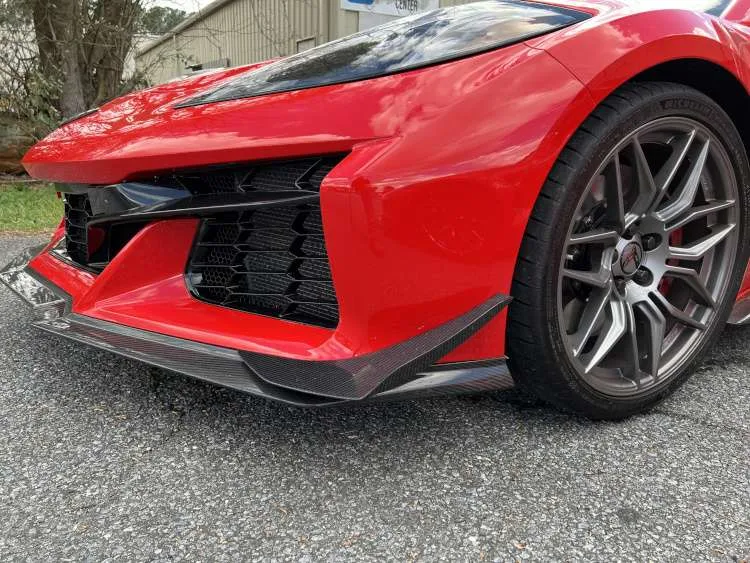
- C8 Z06: Features a sophisticated five-radiator system designed for sustained track abuse. The side air intakes allow the car to run indefinitely in high ambient temperatures without timing pull.
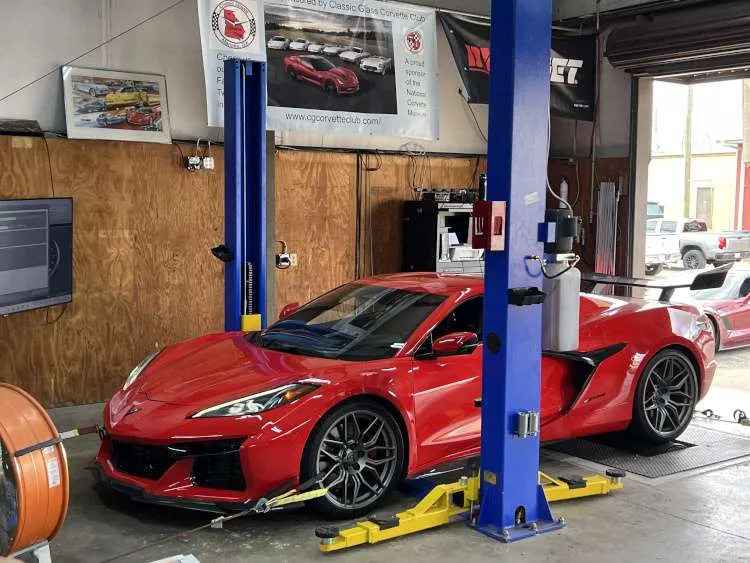
The C8 Z06: The Surgical Strike
If the C7 Z06 is a heavyweight boxer, the C8 Z06 is a world-class fencer. The moment Scott climbs out of the “Wrestler” and into the “Surgeon,” the entire atmosphere changes.
The Learning Curve of Precision
Transitioning to the mid-engine platform wasn’t an overnight success. Scott admits it took about six to eight track events to truly “find the rhythm” of the C8.
- The Physics Shift: Because the engine sits in the middle, the car doesn’t dive under braking or squat under acceleration the way the C7 does. It pivots around the driver’s spine.
- Trusting the Aero: The C8 relies heavily on high-speed aerodynamics. Scott had to learn to trust that the car would stick in corners where the C7 would have already broken loose.
- The High-RPM Game: The C8’s LT6 engine is a flat-plane crank masterpiece that revs to a staggering 8,600 RPM. Scott had to train his brain to wait for that high-pitched wail before pulling the shift paddle.
The cockpit feels less like a traditional car and more like a fighter jet, with the engine’s scream sitting just inches behind his shoulder.
Sensory Sidebar: The View Over the Cowl
- The C8 Corvette cowl is incredibly low. With no engine in front of you, the view is panoramic. The track feels like it is rushing directly under your feet, allowing you to place the front tires on a dime. It changes your perception of speed entirely.
The Fellows Factor: Where Muscle Meets Mathematics
The biggest “Gold Insight” here is what we call the Fellows Factor.
Pro instructors at Ron Fellows Performance Driving School often see a 2-second blowout in lap times between these generations. The C8 is objectively faster, but it requires you to stop wrestling and start thinking.
The lightning-fast Dual-Clutch Transmission (DCT) removes the physical labor of shifting, freeing up your mental bandwidth to focus entirely on your line and the 8,600 RPM redline.
Technical Differentiation: Torque vs. Revs
The mechanical heart of these two cars dictates their track personality:
- C7 (Pushrod LT4): Features a massive, flat torque curve. It makes as much grunt as it does horsepower, providing instant “get-up-and-go” at any gear. It’s a sledgehammer.
- C8 (DOHC LT6): A pure “screamer.” Power builds exponentially. It feels less “punchy” at 3,000 RPM than the C7, but it becomes a relentless, soaring force as it nears that flat-plane crank redline.
| Component | C7 Z06 (The Wrestler) | C8 Z06 (The Surgeon) |
| Brake Wear | Heavy front-end load; destroys front pads quickly. | Balanced wear across all four corners; composed feel. |
| Tire Life | Low-end torque “greases” and shreds rears on corner exit. | Kinder to rears, but requires higher lateral grip compounds. |
| Sound | Loud supercharged grunt; risks black flags at quiet tracks. | 8,600 RPM exotic scream; factory tuned for decibel compliance. |
The DCT Advantage
The biggest departure from the C7’s “row-your-own” engagement is the 8-speed Dual-Clutch Transmission (DCT). While purists might miss the third pedal, Scott highlights a massive track-day truth: the DCT lets you focus.
- Mental Bandwidth: Without the need to rev-match or wrestle a shifter, Scott can dedicate 100% of his brainpower to hitting the apex and managing his line.
- Shift Speed: The shifts are instantaneous and seamless, meaning the chassis stays perfectly settled even when changing gears mid-corner—something that would unsettle the C7 instantly.
Ready Out of the Box
Perhaps the most refreshing change for Scott was the C8’s reliability. Unlike the C7, which required a $15,000 “tax” in cooling mods just to survive a Georgia summer track day, the C8 Z06 arrived ready for battle.
The thermal management is light years ahead, allowing Scott to run hard session after session without watching the temp needle with one eye.
In the C8, you don’t feel like you’re fighting for your life. You feel like you’re performing surgery at 150 mph. It’s clinical, it’s remarkably fast, and it rewards a driver who values finesse over brute force.
The Technical Toll—Consumables and Reality
After the adrenaline fades and the cars are back on the trailers, the conversation shifts to the “cost of doing business.” Scott’s dual-ownership offers a rare look at how these two machines treat their hardware over a long weekend of abuse.
The difference in how they “consume” a track is just as stark as how they drive.
The Battle of the Brakes
Both cars are heavy hitters that demand top-tier stopping power, but they treat their rotors and pads very differently.
- The C7 Weight Bias: Because the C7 carries so much weight up front, it leans on its nose during every heavy braking zone. This puts immense stress on the front rotors and pads, requiring Scott to run aggressive race compounds just to maintain a consistent pedal feel.
- The C8 Balance: The mid-engine layout of the C8 allows for much more balanced braking. While it still uses high-end race pads, the wear is more evenly distributed across all four corners, giving the car a more “composed” feel when diving into a hairpin.
The Rubber Meets the Road
If you want to track a Z06, you have to be comfortable with your tire budget disappearing into thin air.
- Torque vs. Tires: The C7’s massive low-end torque is a tire’s worst enemy. Scott notes that it’s incredibly easy to “grease” the rear tires by being just a hair too aggressive on the throttle exit.
- The C8 Grip Requirement: The C8 is much kinder to its rear tires under power, but because it carries higher speeds through the corners, it demands a stickier, more resilient compound to keep that mid-engine balance from turning into a high-speed slide.
| Component | C7 Z06 (The Wrestler) | C8 Z06 (The Surgeon) |
| Brake Bias | Front-Heavy: Shreds front pads under dive. | Neutral: Even wear; flat chassis under braking. |
| Tire Life | Torque-Limited: Rears “grease” from 740 lb-ft. | Heat-Limited: High lateral Gs require max grip. |
| Acoustics | Subsonic Grunt: Risks dB “Black Flags.” | Exotic Scream: Track-compliant exhaust tuning. |
The Final Verdict: Hero or Professional?
As the sun sets on the paddock, Scott boils it down to a choice of personality.
- The C7 Legacy: The C7 is for the driver who wants to be a hero. It’s a car you have to master, a car you have to fix, and a car you have to fight. It rewards the bold and punishes the lazy.
- The C8 Future: The C8 is for the driver who wants to be a professional. It’s a precision instrument that asks you to stop wrestling and start thinking. It moves the goalposts of what a Corvette can do, trading raw drama for relentless, clinical speed.
- “If I’m honest,” Scott says with a grin, “I still recommend a C5 as the best way to start tracking. But if you want the ultimate thrill? You pick the Z06 that matches your soul—the one that fights back, or the one that flies.”
The Practical Track Rat’s Guide
Owning both cars gives Scott a unique perspective on the “hidden” side of track days—the stuff you don’t see in the glossy brochures. Beyond the lap times, there is the reality of living with these machines in the paddock.
Noise, Neighbors, and Nuance
While we often think “louder is better,” the track doesn’t always agree.
- The Noise Violation: Scott notes that the C7, especially with its performance modifications, became “too loud” for certain tracks with strict decibel limits.
- The Exotic Solution: Interestingly, while the C8’s flat-plane crank screams at 8,600 RPM, its factory exhaust is engineered to be more socially—and track—acceptable, allowing him to run at venues where the C7 might get him “black-flagged”.
Reliability: The Peace of Mind Factor
The most telling difference for anyone looking to enter the Z06 world is how much work happens between sessions.
- C7 Maintenance: With the C7, Scott is constantly managing the car’s temperature and cooling systems, ensuring his $15,000 in modifications are doing their job.
- C8 Maintenance: With the C8, the maintenance is surprisingly simple: check the oil, monitor the tires, and go. It’s a factory-built race car that doesn’t require a mechanic’s constant intervention to stay on track.
The Advice for the Next Generation
Despite owning two of the most capable Corvettes ever built, Scott’s final piece of advice for newcomers is grounded in reality.
- The Starter Car: He still recommends starting with a C5 Corvette. It’s light, communicative, and affordable enough to learn the basics of car control before stepping into the 600+ horsepower world of the Z06.
- The Transition: He believes that learning to drive a slower car fast makes you a much better pilot when you eventually buckle into a “Surgeon” like the C8.
Whether you prefer the mechanical wrestling of the C7 or the clinical, high-RPM flow of the C8, one thing is certain: the Z06 remains the king of the American paddock.
Scott Marshall isn’t just driving history; he’s proving that regardless of where the engine is placed, the soul of the Corvette is still built for the track.

The Final Lap: Choosing Your Weapon
As the sun dips below the horizon at the track, the choice between the C7 and C8 Z06 boils down to a fundamental question: What kind of driver do you want to be?
The Soul of the Machine
Scott Marshall’s journey through these two platforms proves that “progress” isn’t just about faster lap times; it’s about a change in philosophy.
- The Emotional Peak: The C7 Z06 remains the pinnacle of the front-engine era, offering a raw, mechanical connection that requires muscle and grit to master.
- The Technological Peak: The C8 Z06 represents a leap into the future, providing a refined, exotic experience that rewards mental focus and precision over brute force.

Final Thoughts from the Paddock
Scott’s dual-ownership highlights that you don’t necessarily have to “pick a side.” Instead, you choose the experience that feeds your passion on that particular weekend.
Whether you want to wrestle a manual beast or perform surgery with a flat-plane crank, the Z06 badge ensures you’re driving one of the finest track machines ever to come out of Bowling Green.
“At the end of the day,” Scott notes as he packs up his gear, “the C7 makes me feel like I’ve accomplished something, but the C8 makes me realize how much further I can go.”
Archival Metadata: Primary Record
Taxonomy (LCSH): Corvette automobile—Performance—Testing | Mid-engine automobiles—Design and construction | Automobiles—Maintenance and repair—Equipment and supplies | Sports cars—United States—History—21st century
Technical Standard: Comparative performance analysis of LT4 supercharged (front-engine) vs. LT6 flat-plane crank (mid-engine) powertrain architectures; evaluation of thermal management and DCT integration.
ISSN 3071-3099 (Online) | Official Selection: U.S. Library of Congress Web Archives (ID 50193) | Master Technical Index
Secure Your Weekly Briefing
Join a global community of Corvette stewards. Access forensic deep-dives and high-octane field records—delivered with total editorial independence.
START YOUR BRIEFING


