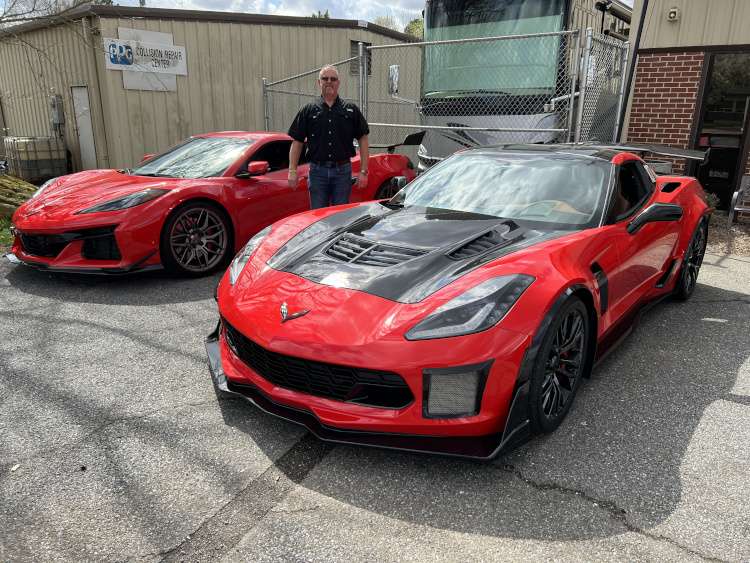


Catapano Corvettes LLC
Key Takeaways: The Dual-Threat C6 Build
- Mechanical Optimization: Bob Catapano’s “Dual-Threat” C6 utilizes a 6L80 automatic transmission, re-tuned via the Transmission Control Module (TCM) to eliminate shift dwell. This “accidental” purchase became a tactical advantage, enabling precise, high-speed carving without the distraction of manual clutching.
- Performance Metrics: The build achieves a consistent 435 HP at the wheels (~500 HP crank) through LS3 engine optimization, including Z06 exhaust scavenging and custom fuel trimming for thermal safety at sustained 150+ MPH speeds.
- Physics-Driven Handling: Performance is anchored by Bridgestone RE-71RS tires, utilizing Molecular Hysteresis to sustain 1.1g to 1.2g lateral loads. High-speed stability is managed through an aerodynamic package (splitter/wing) that creates a chassis “squat” above 110 MPH.
- Thermal Management: Reliability is secured via an all-aluminum 3-row radiator and auxiliary transmission cooling, allowing for consistent 20-minute track sessions without triggering “limp mode.”
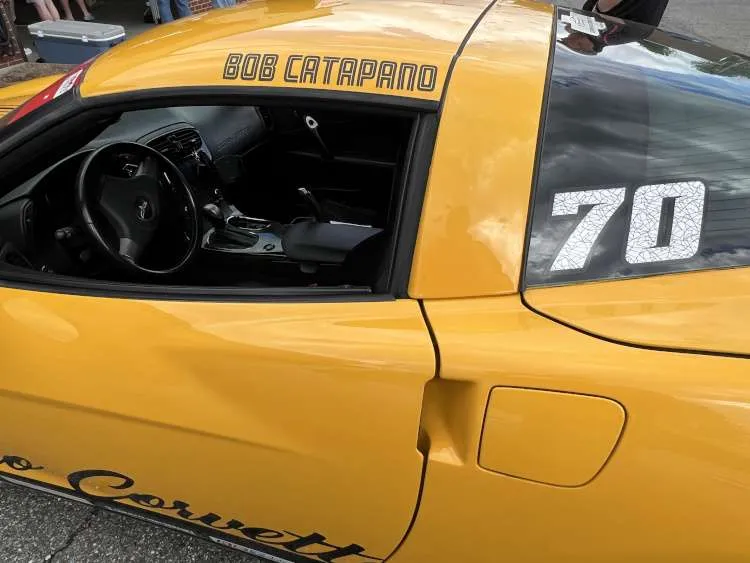
The Authority Behind the Build: Bob Catapano
When Bob Catapano offers advice on the C6 Corvette, it isn’t theory—it’s a philosophy forged in the high-heat pressure cooker of the American road course.
As the owner of Catapano Corvettes ([email protected]) in Woodstock, Georgia, Bob possesses a rare “busted knuckle” pedigree that began in New York junkyards and evolved into a career of mechanical mastery.
A seasoned SCCA racer, Bob has logged thousands of miles at the limit, giving him a visceral understanding of how the C6 platform reacts under extreme lateral G-forces and thermal stress. Because he both restores the analog classics and optimizes modern EFI predators, he bridges the gap between old-school intuition and digital precision.
Whether he’s re-engineering a “truck” gearbox for 160 MPH sprints or mastering the molecular physics of tire grip, Bob’s wisdom is the result of decades spent proving that a true Corvette should never have to choose between the interstate and the apex.
From Restoration to Redline: The Architecture of a Dual-Threat C6
The red clay of Georgia has a way of staining everything it touches, but for Bob Catapano, the stain wasn’t on his boots—it was on his soul.
It happened in 2017 at Michelin Raceway Road Atlanta. While most Corvette purists spend their Saturdays polishing chrome in a parking lot, Bob decided to see what his C5 Z06 could actually do when the shackles came off.
Bob isn’t just another weekend warrior; he’s the mastermind behind Catapano Corvettes in Woodstock, Georgia. He spends his workweek meticulously restoring the legends of the past, but his weekends belong to the high-decibel world of High-Performance Driving Education (HPDE).
His philosophy is the “Holy Grail” of Corvette ownership: The Dual-Threat Vette. Bob demands a car that can hunt down exotic European steel at 150 MPH on Sunday, yet still possess enough manners to cruise to New York on Monday with the A/C cranking and the radio clear.
He didn’t just want a track car; he wanted a machine that lived two lives.
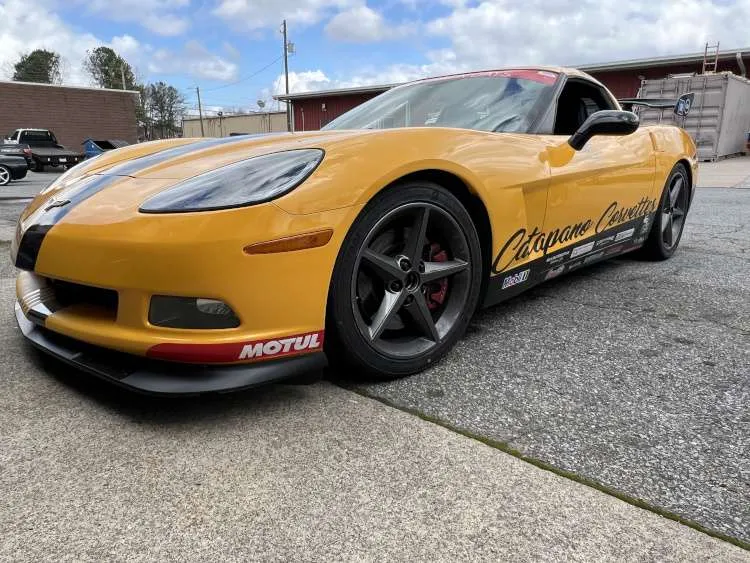
The 1,000-Mile Hunter
In the world of Corvette tuning, you usually have to pick a lane: a “Trailer Queen” track rat that requires a kidney belt to drive to the grocery store, or a soft “Waxer” that wilts under the heat of a three-lap sprint.
Bob rejects that binary. He demands the 1,000-Mile Hunter—a machine engineered for the “Long-Haul Hustle”.
Bob’s current C6 isn’t just a local hero; it’s a car that can tackle a 900-mile transit from Georgia to New York in total civility—satellite radio humming, cruise control set, and the cabin kept at a crisp 68°F.
Yet, once it rolls through the gates of a circuit like Watkins Glen, it sheds its manners. With a simple swap of the brake pads and a quick tire pressure adjustment, the daily driver transforms into a high-G predator capable of sustaining 150 MPH on the straights and hunting down dedicated race builds.

The Evolution and the “Accidental” Automatic
Every legendary Corvette build has a “Phoenix” moment. For Bob Catapano, that moment was a mechanical scream at Road Atlanta. His C5 Z06—a manual-shifting purist’s dream—suffered a catastrophic timing chain failure.
While most would see a blown motor as a tragedy, Bob saw a blank canvas.
He set his sights on a 2008 C6 to secure the LS3 engine, a platform known for better flow and more tuning overhead than its predecessors. He found his “perfect” car in Texas, wired the funds, and waited.
When the transport truck lowered the ramp in Georgia, Bob reached into the cabin and felt his heart sink: no clutch pedal.
The Texas Surprise
The seller had mislisted the car. Bob had accidentally purchased a 6-speed automatic. Initially horrified, Bob faced a crossroads: flip the car immediately or test the “slush-box” on the circuit.
“I thought I made a massive mistake,” Bob admits. “But then I got it on the track. I realized that by keeping both hands at nine-and-three, I wasn’t just driving; I was carving. I was out-pacing guys who were still busy fumbling for third gear.”
Sidebar: The 6L80—From Workhorse to Racehorse
To the uninitiated, the 6L80 transmission is a “truck” gearbox, designed to haul trailers in a Chevy Silverado or move families in a Suburban. So, how does it survive a 160 MPH sprint at Daytona?
- Clutch Capacity: Unlike lighter passenger car units, the 6L80 features a robust clutch-to-clutch architecture that handles the LS3’s high torque without slipping.
- The “Brain” Swap: The real magic isn’t mechanical; it’s digital. By re-tuning the Transmission Control Module (TCM), Bob reduced the “shift dwell”—the lag between pulling the paddle and the gear engaging—to near-instantaneous levels.
- Heat Management: In a truck, this unit runs cool. On a track, it’s a furnace. Bob’s “Dual-Threat” setup relies on an auxiliary cooling loop to prevent the fluid from foaming under the extreme pressures of high-RPM downshifts.
“There’s nothing quite like the look on a manual driver’s face when they realize the ‘automatic’ just out-shifted them while they were busy fumbling for third gear,” Bob laughs.
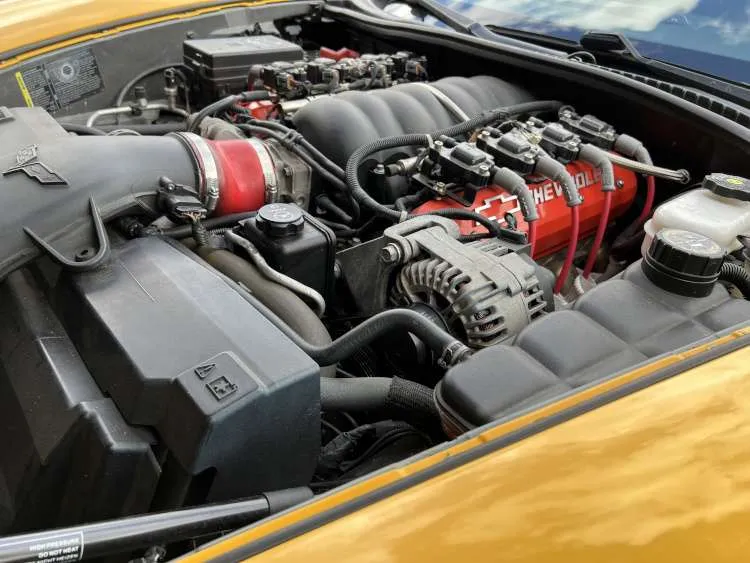
The “Brain” Swap: Overclocking the TCM
In stock form, the 6L80 is programmed for “passenger comfort”. When you pull a paddle, the computer asks a dozen questions about fuel economy and shift smoothness before finally executing the gear change. For a track car, that delay is an eternity.
Bob’s “Brain Swap” involves a deep-level recalibration of the Transmission Control Module (TCM). We aren’t just making it shift harder; we’re making it shift smarter.
- Pressure Profiling: By increasing the line pressure during high-load scenarios, the TCM forces the clutch packs to engage with zero slip. This creates that “mechanical snap” felt in high-end sequential race boxes.
- Torque Management Reduction: On the street, the car’s ECU actually cuts power for a split second during a shift to protect the drivetrain. Bob’s tune dials this back, allowing the LS3 to keep pushing through the gear change, maintaining crucial momentum on the exit of a turn.
- Downshift Rev-Matching: The most critical “Elite” upgrade is the blip. The tuned TCM coordinates with the engine to “blip” the throttle on downshifts. This synchronizes engine RPM with wheel speed, preventing the rear tires from locking up and unsettling the chassis when diving into a heavy braking zone.
The Tactical Advantage
The automatic didn’t just change how Bob shifted; it changed how he raced.
Without the physical distraction of rev-matching and clutching, Bob could focus entirely on his braking markers and apex precision. The car stayed balanced because the shifts were computer-perfect, preventing the weight-transfer jolts that often unsettle a manual car mid-corner.
The “mistake” from Texas had become his secret weapon.
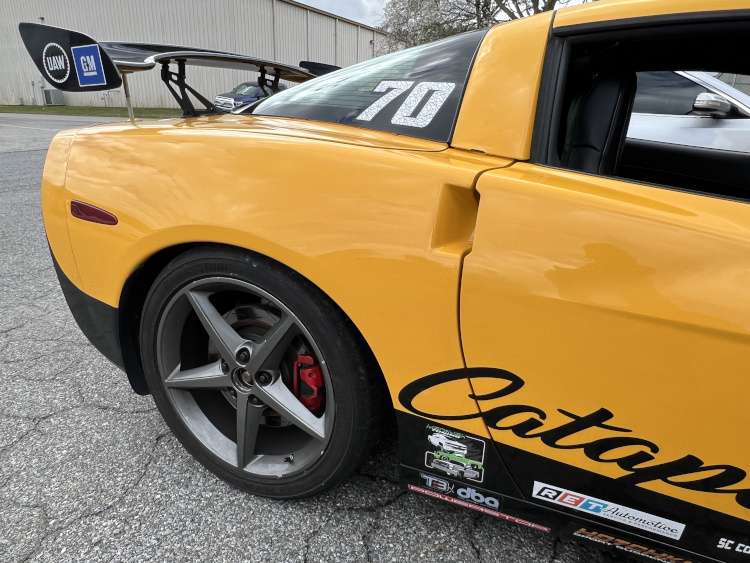
The Dual-Threat Compromise Scale
Most builds fail because they lean too far into one camp. Bob’s “Sweet Spot” keeps the car in the high-performance overlap.
| Feature | The “Waxer” (Street) | The “Rat” (Race) | Bob’s “Dual-Threat” |
|---|---|---|---|
| Cooling | Stock Plastic Radiator | Massive Front-Mount | All-Aluminum 3-Row |
| Suspension | Soft Transverse Leaf | Bone-Jarsing Coilovers | Bilstein Race Shocks |
| Exhaust | Silent Stock | Ear-Bleeding Straight Pipe | Z06 Swap w/ Mild2Wild |
| Creature Comforts | Full Interior / AC | Stripped / No AC | Full Interior + Track Aero |
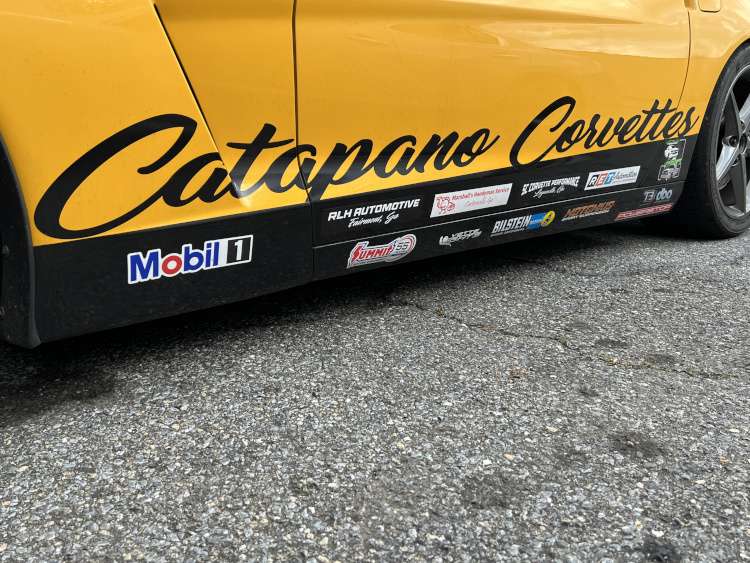
The Build—Engineering the 1,000-Mile Hunter
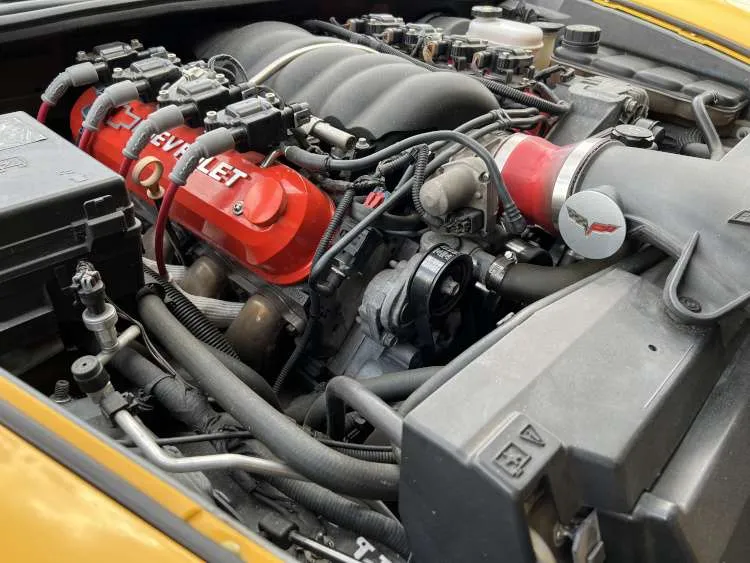
With the 6L80 transmission now speaking the language of the track, Bob turned his attention to the heart of the C6: the LS3 engine.
A stock LS3 is a masterpiece, but the sustained high-RPM environments of Road Atlanta or Daytona demand more than factory settings. Bob’s goal was clear: increase the “punch” while ensuring the car never broke a sweat during a 900-mile transit.
The “Deep Breath”: Airflow and Spark
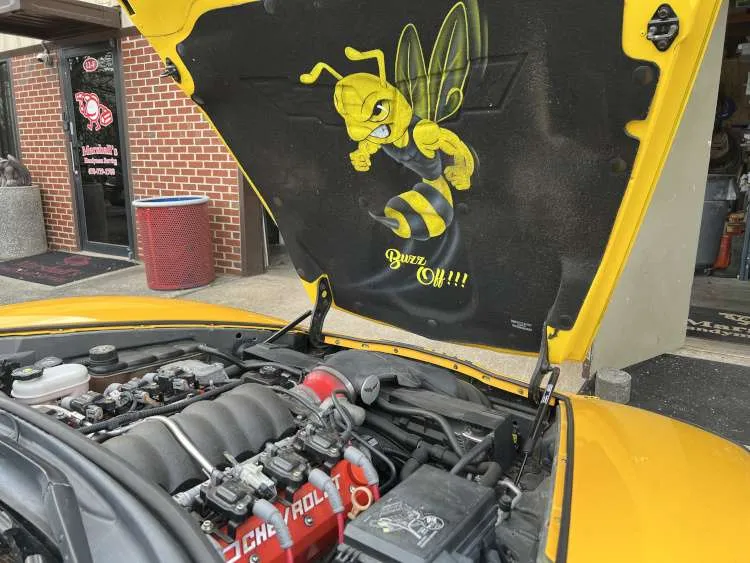
Bob optimized the engine’s breathing and firing efficiency without cracking open the block.
- The Intake: An upgraded cold-air system ensures the LS3 pulls dense, oxygen-rich air.
- The Injectors: High-flow injectors provide the necessary fuel volume to match the increased air, preventing a “lean” condition at 150 MPH.
- The Spark: Upgraded ignition coils provide a hotter, more consistent spark, essential for maximizing combustion under heavy loads.
- The Exhaust: Bob swapped the restrictive stock pipes for a full Z06 exhaust system, using factory-engineered flow to maximize scavenging.
The Digital Dyno: Finding the “Safe” Edge
To tie these components together, the car hit the rollers for a custom chassis dyno tune. This wasn’t just about chasing a peak number; it was about reliability mapping.
- Fuel Trimming: The tuner adjusted the “Long Term Fuel Trims” (LTFTs) to ensure the engine runs slightly rich at wide-open throttle. This extra fuel acts as a coolant for the pistons during long-duration high-speed runs.
- Timing Advancement: By precisely advancing the ignition timing just before the point of “knock,” Bob extracted a consistent 430–435 HP to the rear wheels.
- The Result: This translates to roughly 500 HP at the crank. More importantly, the power curve is linear and predictable—exactly what a driver needs when modulating the throttle mid-corner.
Thermal Management: The 3-Row Solution
Heat is the primary enemy of an automatic track car. Bob threw out the factory radiator and its plastic end tanks, which are notorious for cracking under the thermal expansion of racing.
In its place, he installed a heavy-duty 3-row all-aluminum unit.
By pairing this with a 180-degree thermostat, Bob ensured the engine and transmission fluids stay within their “happy” operating windows.
This allows for back-to-back 20-minute sessions in the Georgia heat without the computer pulling timing or the car entering “limp mode”.
The Sound of Stealth
Bob utilizes Multi-Mode Exhaust (MMP) mufflers to maintain his “Dual-Threat” status. On the highway to New York, the valves remain closed for a quiet, drone-free cabin. At the starting grid, he flips a switch, the valves snap open, and the LS3 barks with the authority of a dedicated race car.
Handling and Braking—Carving the Red Clay
If the engine is the heart of Bob’s C6, the suspension and braking systems are the nervous system. Power is useless if you can’t plant it, and 160 MPH is terrifying if you can’t scrub it off before a hairpin.
Bob’s approach to handling follows his “Dual-Threat” mantra: high-performance capability without the bone-shattering ride of a dedicated track-only rig.
Suspension: The Low-Profile Advantage
Bob didn’t just lower the car for aesthetics; he lowered it for physics. By dropping the ride height, he lowered the center of gravity and reduced the amount of air traveling under the chassis, which is the first step in effective aerodynamics.
- The Springs: He retained the lightweight fiberglass leaf springs, which offer a unique “side-to-side” damping effect that coils often lack.
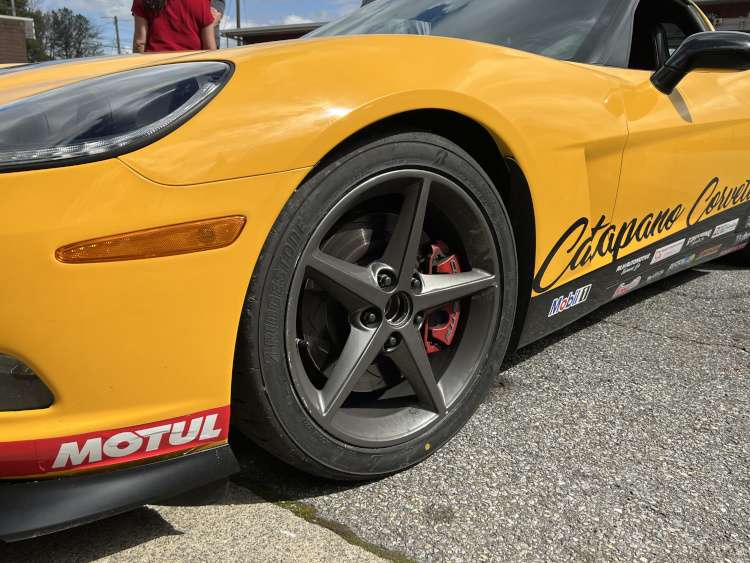
- The Shocks: Rather than complex and finicky coilovers, Bob opted for Bilstein Race Shocks. These are “set-it-and-forget-it” units that provide the high-speed rebound needed for the track while remaining civil on the interstate.
- The Sway Bars: Upgraded front and rear sway bars keep the car flat, preventing the body roll that can unsettle a Corvette mid-corner.
Braking: Australian Steel and Race-Day Pads
Coming off the back straight at Road Atlanta, you’re asking the car to shed massive amounts of kinetic energy. To handle the heat, Bob moved away from the stock “waxer” setup.
- The Hardware: He utilizes larger GM calipers paired with high-quality Australian-sourced rotors. These rotors are designed to vent heat more efficiently than standard domestic versions.
- The Friction: For track weekends, Bob swaps in PowerStop “Race Day” pads. These pads require heat to work—on the street, they might squeal, but at 400°F, they bite like a shark.
- The Fluid: He runs high-temp racing brake fluid to prevent “pedal fade,” ensuring the brakes feel the same on lap 15 as they did on lap 1.
The Physics of the “Cheat Code”: Bridgestone RE-71RS
Tires are the only part of the car actually touching the track. Bob’s weapon of choice is the Bridgestone RE-71RS, a 200-treadwear tire that balances track grip with street manners.
The RE-71RS solves the “Goldilocks” problem—being neither too hard nor too soft—through three specific physical properties:
- Molecular Hysteresis: The tread compound uses a high-grip polymer that deforms and recovers rapidly. This “hysteresis” allows the rubber to wrap around microscopic imperfections in the asphalt, creating a mechanical bond before the tire even reaches full operating temperature.
- The “Square” Contact Patch: Unlike standard performance tires with rounded shoulders, the RE-71RS features a squared-off profile. Under heavy cornering loads, the tire maintains a consistent, flat footprint rather than “rolling” onto the sidewall.
- Thermal Sink Capacity: Vertical grooves act as heat sinks, pulling thermal energy away from the tread surface to prevent “greasing over,” where tires lose grip due to extreme heat.
The Result on the G-Meter
For Bob, this physics lesson translates to a tangible advantage. While a standard street tire might pull 0.9g in a turn, the RE-71RS allows the C6 to sustain 1.1g to 1.2g.
This allows Bob to carry significantly higher speeds through technical sections like “The Esses” at Road Atlanta.
“The beauty of the RE-71RS,” Bob says, “is that the grip is linear. It doesn’t just ‘let go.’ It talks to you through the steering wheel, letting you know exactly how much more you can push before the physics of friction give up”.
Aerodynamics—The 100 MPH Squat
When a Corvette nears triple digits, it stops acting like a car and starts acting like a wing. Without intervention, air pressure builds up under the chassis, creating lift that turns a stable machine into a nervous, light-footed ghost.
For Bob’s C6, the aerodynamic package isn’t for show—it’s the “glue” that allows him to stay pinned at 160 MPH.
Managing the Airflow: Front to Back
Bob’s aero strategy focuses on two objectives: keeping air out from under the car and using the air passing over it to push the chassis into the asphalt.
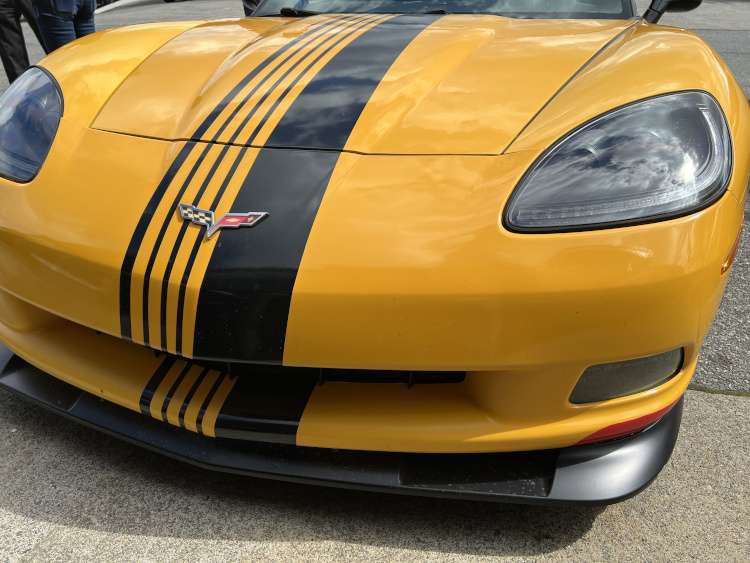
- The Front Splitter: This large front spoiler acts as a barrier, forcing high-pressure air to go over the hood rather than under the belly of the car.
- Creating the Vacuum: This redirection creates a low-pressure zone beneath the engine, effectively “sucking” the front tires into the track.
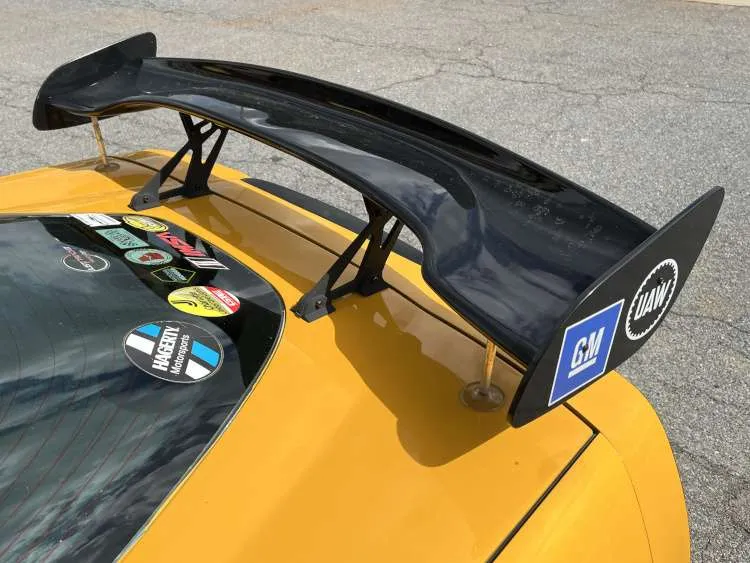
- The Rear Wing: At the back, a substantial wing catches the fast-moving air and deflects it upward.
- The Downforce Effect: According to Newton’s third law, this deflection creates a powerful downward force on the rear tires, increasing mechanical grip.
The “Drag” Trade-off and Dirty Air
Elite aero isn’t just about sticking to the ground; it’s about managing the air you leave behind.
- The Drag Penalty: Bob carefully balances his wing angle. While more angle creates more grip in technical turns, it also increases drag, which can act like a parachute on the back straight.
- Drafting Dynamics: Bob has to account for “dirty air” when following other cars closely. In a draft, the front splitter loses its clean airflow, which can cause the front end to push (understeer) until he pulls out to pass.

The Performance Threshold: The 110 MPH “Settle”
Aero is a game of squares: double your speed, and you quadruple your downforce. Because Bob’s aero components are optimized for track speeds, they remain largely “invisible” during a casual highway commute.
“You don’t feel it at 60 or 70,” Bob explains. “But once you cross that 100 to 115 MPH threshold, the car changes. You can actually feel the chassis ‘squat’ as the air takes hold. It becomes rock-solid”.
Downforce vs. Velocity: The Grip Curve
This table illustrates why the car feels increasingly “heavy” and stable as Bob accelerates down the back straight.
| Speed (MPH) | Aero Effect | Driver Sensation |
|---|---|---|
| 60 MPH | Negligible Downforce | Standard “Street” feel; light steering. |
| 90 MPH | Downforce begins to offset Lift | Steering becomes more communicative. |
| 120 MPH | Significant Downforce | The “Squat”; the car feels “glued” to the asphalt. |
| 150+ MPH | Maximum Grip | Extreme stability; car resists mid-corner “darting.” |
Tactical High-Speed Stability
At legendary circuits like Daytona or Charlotte Motor Speedway, where banking reaches a dizzying 33 degrees, this aero package is a life-saver.
While an un-winged C6 might feel floaty or “darty” on the high banks, Bob’s car stays planted near the yellow line.
This stability allows him to keep his foot buried on the throttle, reaching speeds of 150–160 MPH with total confidence.

The Driver’s Circuit—Testing the Build
A track car is only as good as the asphalt beneath its tires. For Bob, the Southeastern United States serves as the ultimate laboratory—a region steeped in the Corvette’s own competitive history.
From the high-banked “Roval” at Charlotte to the technical elevation changes of North Georgia, each circuit demands a specific evolution of the C6 platform.
Road Atlanta: The Proving Ground
This is where Bob’s addiction began in 2017 and where he continues to benchmark his progress. Road Atlanta is a high-speed “power track” that punishes poor braking and rewards bravery through the blind crest of Turn 11.
- The Elevation Challenge: Drivers face a massive, stomach-churning drop into Turn 12 while traveling at triple-digit speeds.
- The C6 Advantage: The automatic transmission allows Bob to focus entirely on the compression at the bottom of the hill. He keeps his hands fixed at “nine-and-three” as the chassis loads up, providing a critical safety margin when the car lightens over the crest.
- The Passing Game: Bob notes the specific thrill of “hunting” more expensive European steel on the back straight, relying on his LS3’s 435 WHP to pull away.
The Speedways: Charlotte and Daytona
These tracks offer a unique psychological and physical challenge: the “Big Bank”. Charlotte and Daytona feature banking up to 33 degrees, creating a sensation of being crushed into the driver’s seat by vertical G-forces.
- The High Line: Bob keeps the C6 pinned near the yellow line, relying on his aero package to prevent the car from drifting toward the retaining wall.
- Top End: On the back straights of these motor speedways, the LS3 stretches its legs, reaching sustained speeds of 150–160 MPH.
- The “Roval” Setup: Success at Charlotte requires a compromise; the car must be soft enough to handle the infield road course bumps but stiff enough to keep from “bottoming out” under the massive vertical loads of the NASCAR banking.
The Technical Tests: Roebling Road and Sebring
If the speedways are about raw horsepower, these tracks are about finesse and thermal endurance.
- Roebling Road: Known as the “Country Club” of tracks, its long, sweeping turns test the lateral grip and heat-cycle management of the RE-71RS tires. Bob highlights that this track is where “momentum is king”.
- Sebring (The Ancestral Home): This historic Florida track is notoriously punishing. Composed partly of old World War II B-17 bomber runways, the rough concrete joints act as a “jackhammer” on a car’s suspension.
- Suspension Payoff: Bob’s choice of Bilstein shocks over stiff coilovers pays dividends here, absorbing the chatter that often rattles manual-gearbox cars off their line and unsettles the driver.
Track Performance Comparison
| Track | Surface Type | Bob’s Peak Speed | Primary Build Test |
|---|---|---|---|
| Road Atlanta | Smooth Asphalt | 150 MPH | Braking & Elevation |
| Daytona | High-G Asphalt | 160 MPH | Aero Stability |
| Charlotte | Mixed Roval | 155 MPH | Suspension Compression |
| Roebling Road | Abrasive Asphalt | 135 MPH | Tire Thermal Limits |
| Sebring | Vintage Concrete | 145 MPH | Chassis Durability |
“Every track tells you a different story about your car,” Bob says. “At Daytona, you learn if your aero works. At Road Atlanta, you learn if your brakes—and your nerves—are up to the task”.

The Dual-Threat Blueprint: Finalizing the 1,000-Mile Hunter
Ultimately, Bob Catapano’s C6 is more than just a collection of upgraded components; it is a masterclass in purposeful engineering and a testament to the versatility of the Corvette platform.
By leaning into the perceived “mistake” of the 6L80 automatic, Bob didn’t just adapt—he optimized, proving that digital precision can outmatch analog tradition when tenths of a second are on the line.
It serves as a reminder that the “Holy Grail” of ownership—a high-G predator that maintains its highway manners—is achievable for those willing to look past the clutch pedal.
For Bob, the red clay of Georgia may stain the tires, but the engineering underneath remains a pristine blueprint for the modern enthusiast.
Notice of Purpose and Liability
The article is published by Vettes of Atlanta Magazine for informational, historical, and entertainment purposes only. While the insights provided by Bob Catapano are based on decades of elite technical and competitive experience, they are provided on an “as-is” basis without any express or implied warranties regarding the suitability or safety of these modifications for your specific vehicle.
Professional Consultation Required: The mechanical “forensics” and high-performance calibrations described in this article—specifically regarding transmission tuning, high-speed aerodynamics, and braking systems—are not a substitute for the professional judgment of a certified technician. Readers must verify all technical data and consult with a qualified specialist before attempting any performance modifications.
The Inherent Risks of Speed: High-performance driving and automotive maintenance involve extreme hazards, including mechanical failure, fire, and severe personal injury. Racing conditions place stresses on a vehicle far beyond factory design parameters.
Assumption of Risk: By utilizing the information in this guide, the reader assumes all liability and responsibility for any actions taken. Neither the publisher, editors, nor contributors shall be held liable for any damages—direct, indirect, or consequential—arising from the application of the techniques or builds described herein.
Drive at your own risk; maintain at your own responsibility.
Archival Metadata: Primary Record
Taxonomy (LCSH): Corvette automobile–Performance | Automobiles–Design and construction–Aerodynamics | Transmission, Automotive–Calibration | Sports cars–United States–History–21st century
Technical Standard: Forensic audit of C6 LS3 propulsion systems, 6L80 digital recalibration (TCM), and molecular tire physics (RE-71RS). Verified through Human-in-the-Loop (HITL) track-certified data.
Bibliographic Identity: ISSN 3071-3099 (Online) | Official Selection: U.S. Library of Congress Web Archives (ID #50193) | Master Technical Index
Secure Your Weekly Briefing
Join a global community of Corvette stewards. Access forensic deep-dives and high-octane field records—delivered with total editorial independence.
START YOUR BRIEFING